Visiting the basilica
Inside the Sagrada Família: what to see in the basilica
Columns that branch out like trees, vaults up to 75 m high, blue light in the morning and orange in the evening: the inside of the Sagrada Família is the most striking part of the visit. Here is what to see and understand, in the order of the route, with our own photos.
What to see inside the Sagrada Família: the nave, the columns, the stained glass, the altar, the crypt seen from above and the museum.
- Vaults 45 to 75 m high
- Stained glass by Joan Vila-Grau
- The crypt where Gaudí lies, seen from above

Key facts
The interior at a glance
| Layout | Latin cross with five naves, 90 m long inside |
|---|---|
| Heights | Choir galleries 15 m, side aisles 30 m, central nave 45 m, crossing 60 m, apse 75 m: all multiples of 7.5 m |
| Columns | "Double-twist" columns in sandstone, granite, basalt and red porphyry, depending on the load |
| Light | 289 skylights in the vaults; stained glass by Joan Vila-Grau, made from 1999 to 2022 |
| Altar | A block of porphyry 2.72 m long weighing 7.5 tonnes, under a 5 m heptagonal baldachin |
| Crypt | The oldest part, begun in 1882; tomb of Antoni Gaudí |
| Museum | Under the basilica: models, plans and the story of the construction |
| Time needed | About 1.5 hours on site; official audio guide of 45 or 25 minutes, in 19 languages |
| Quiet hour | 9:00 to 10:00, headphones required |
| Accessibility | The whole basilica is accessible except the towers; entrance B, Carrer de la Marina |
Sources: sagradafamilia.org (official brochure no. 9, "Interior of the basilica", visiting conditions) and the official blog on the stained glass. Checked in November 2026.
The nave
A forest of stone
Gaudí wanted the interior to feel like a forest, a place for contemplation. That is the impression you get from the doorway: no load-bearing walls in sight, only trunks that split into branches and disappear into the vaults.
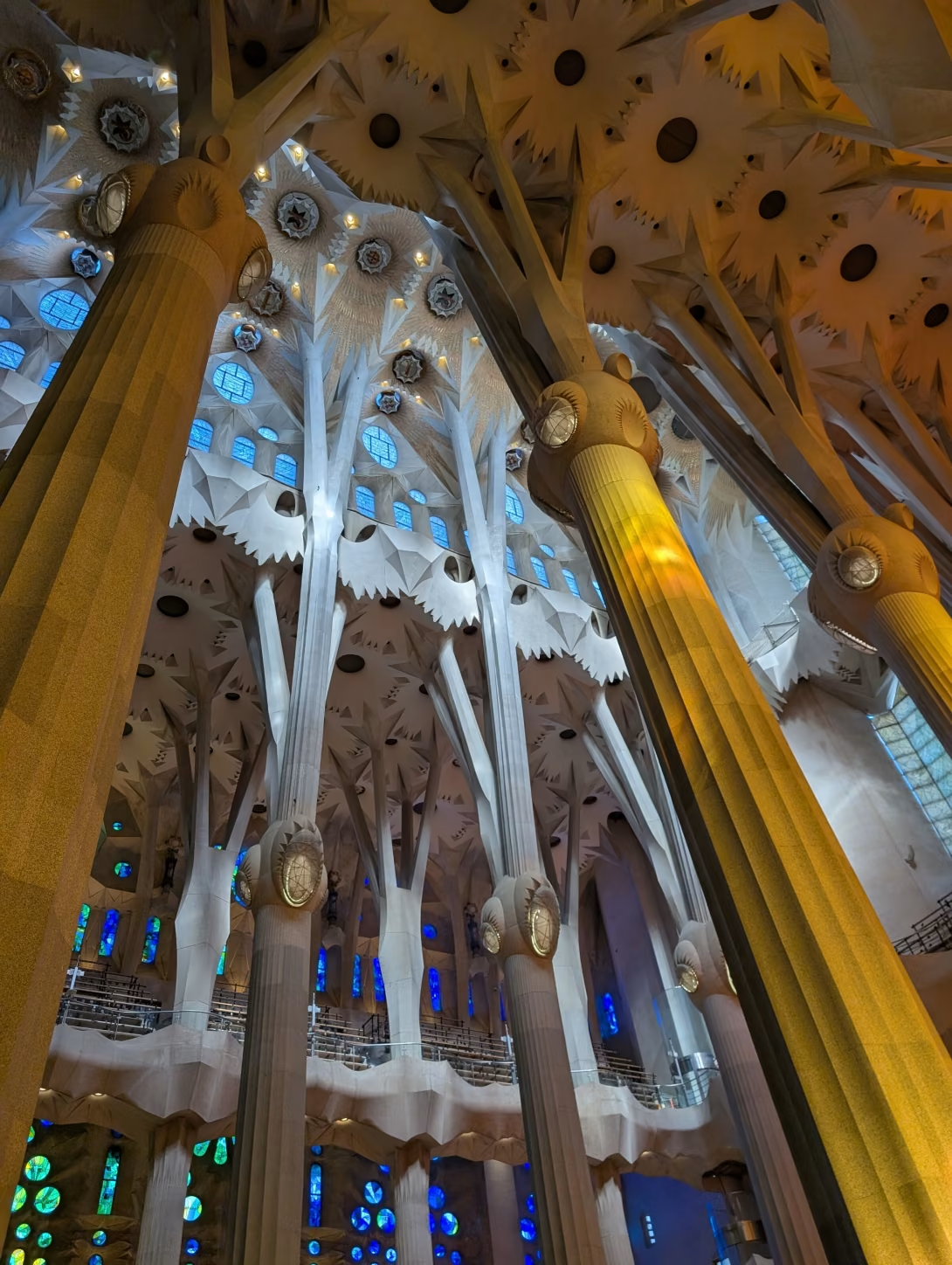
Columns that twist as they rise
Gaudí invented what he called the double-twist column. Its base is a polygon or a star that turns both to the right and to the left as it rises, until it becomes a circle. The column is more stable and looks more slender. At the "knot", the equivalent of a capital, it splits into branches, sometimes several times, which then carry the vaults.
A different stone for each load
The lower part of the columns is not made of a single stone. Gaudí chose each material according to the weight it had to bear: Montjuïc sandstone in the side aisles, granite in the central nave, basalt around the crossing and red porphyry for the four central columns, which support the Tower of Jesus Christ. These stones also give the nave its shades of grey, brown and red.
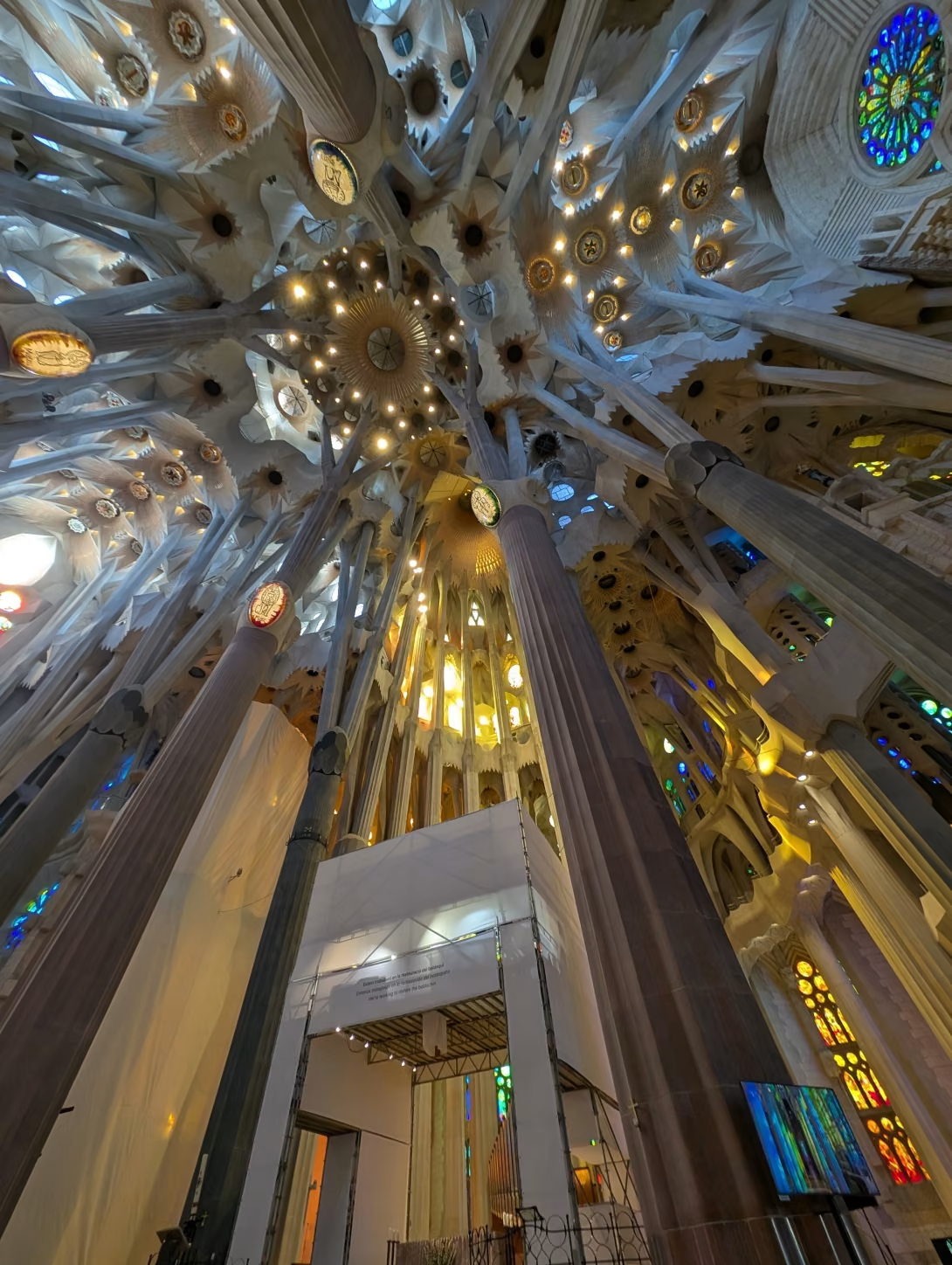
Vaults that rise higher and higher
As you walk from the doors to the altar, the vaults rise: 30 m above the side aisles, 45 m above the central nave, 60 m over the crossing and 75 m above the apse. Every measurement inside is a multiple of 7.5 m. Because the columns are slimmer than in a Gothic cathedral, you can see almost the whole interior from anywhere in the nave.
The vaults are made of intersecting hyperboloids. Those of the side aisles, completed in 1996, are in white concrete. Those of the central nave, closed in 2000, of the crossing and of the apse, completed in 2010, are in flat-laid brick, in the Catalan style. Between the bricks, triangles of green and gold glass mosaic suggest palm leaves. In the middle of each vault, one of the 289 skylights lets in light from above.
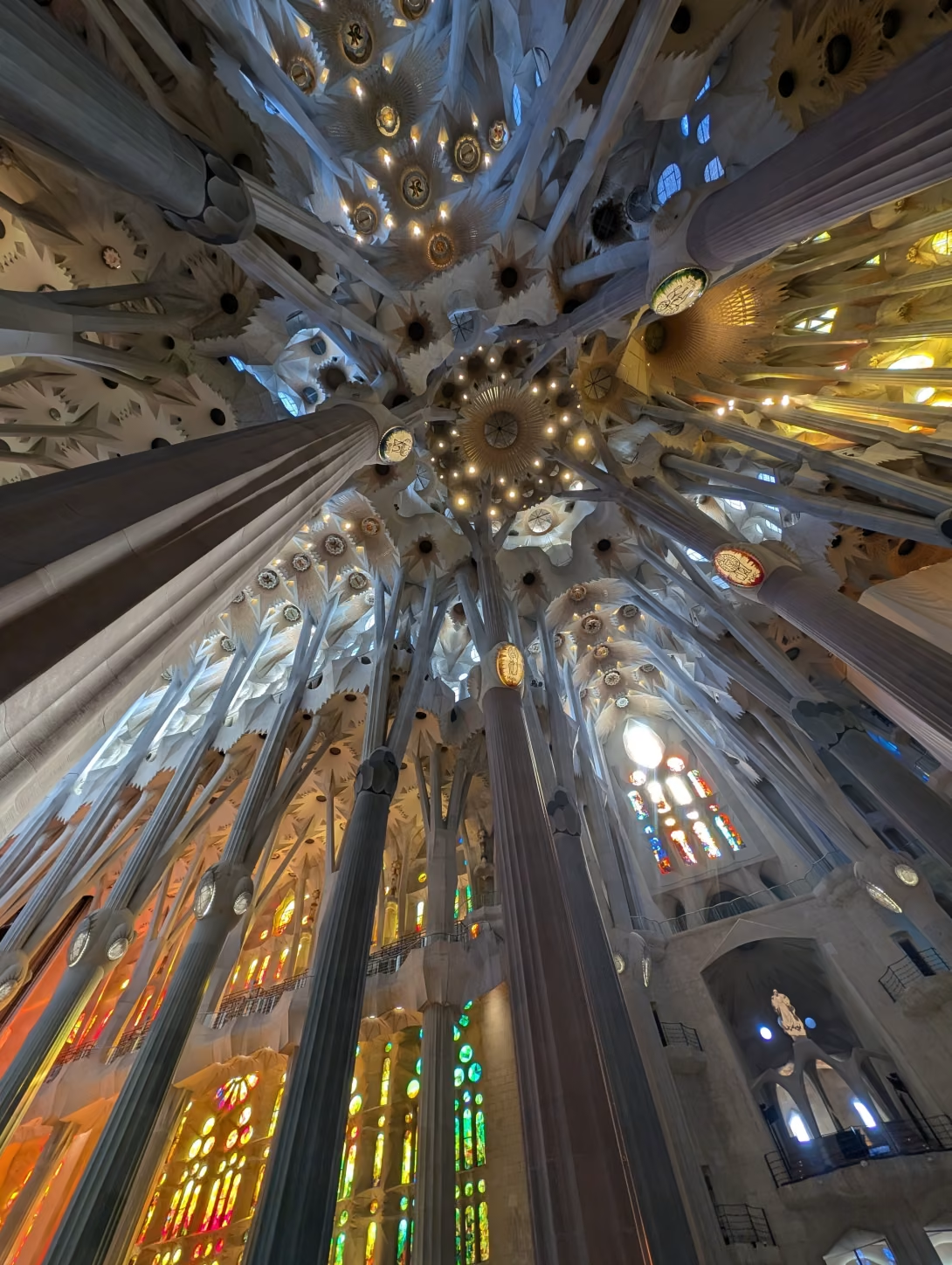
Don't miss
The four Evangelists on the crossing columns
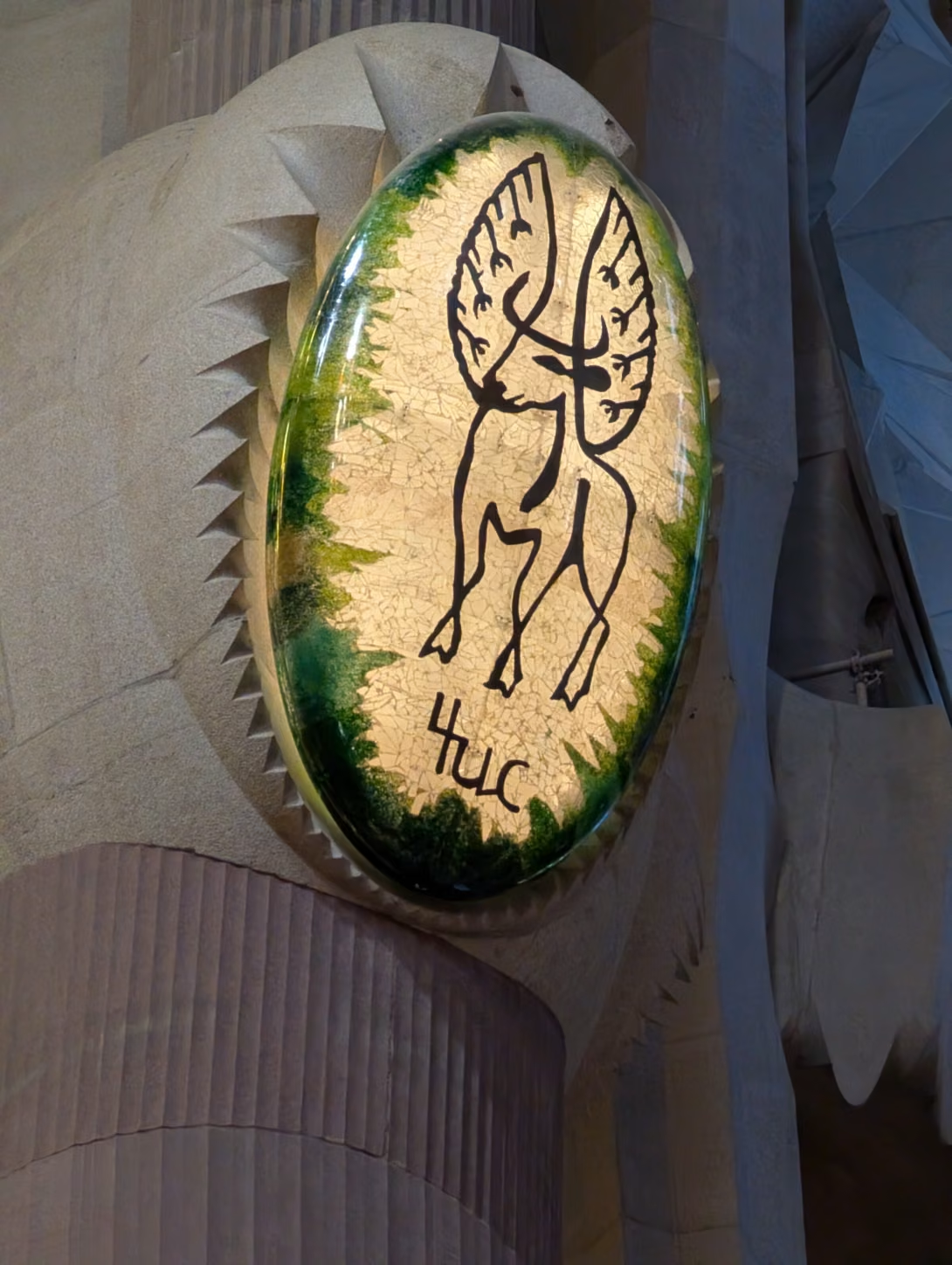
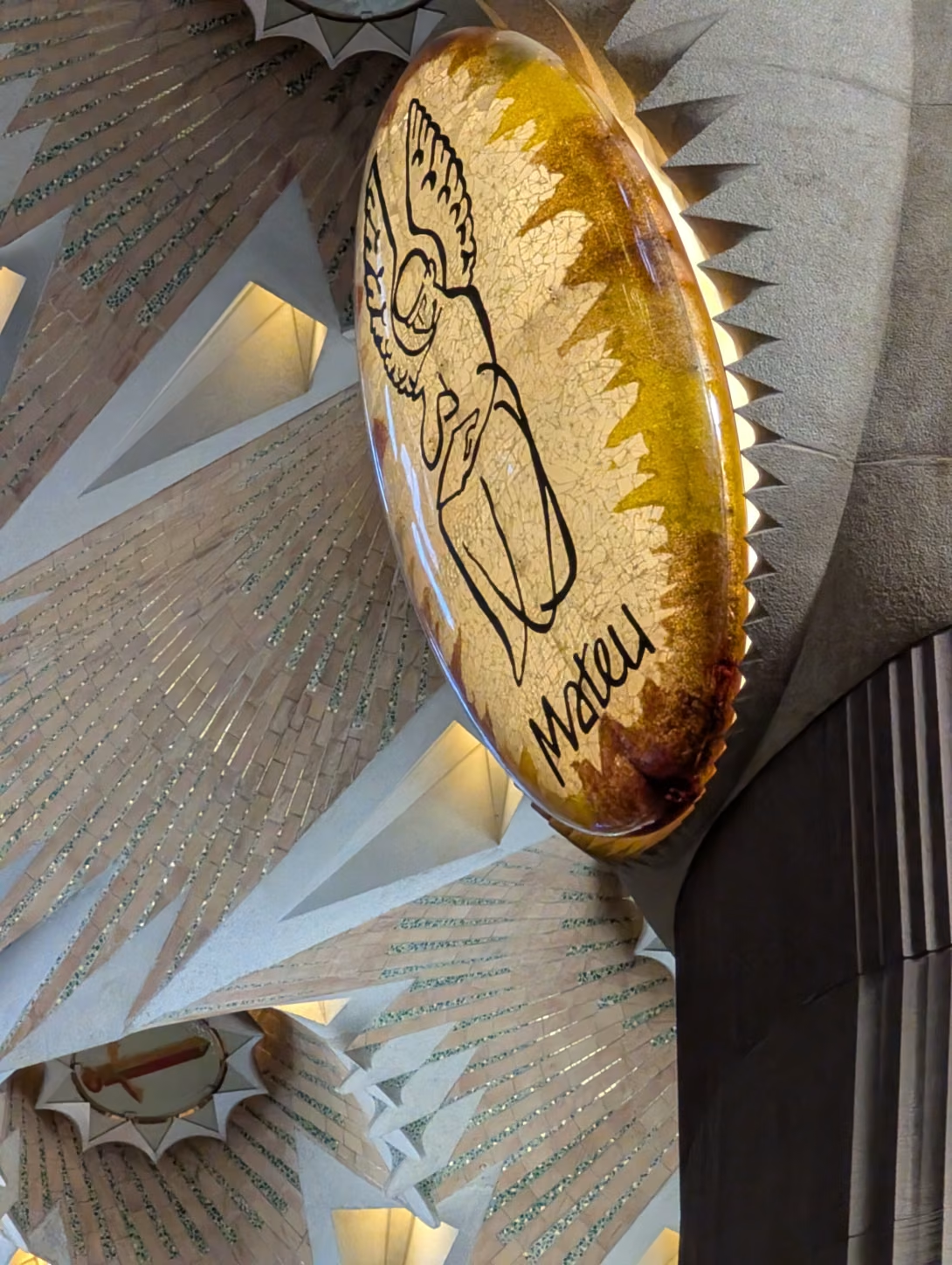
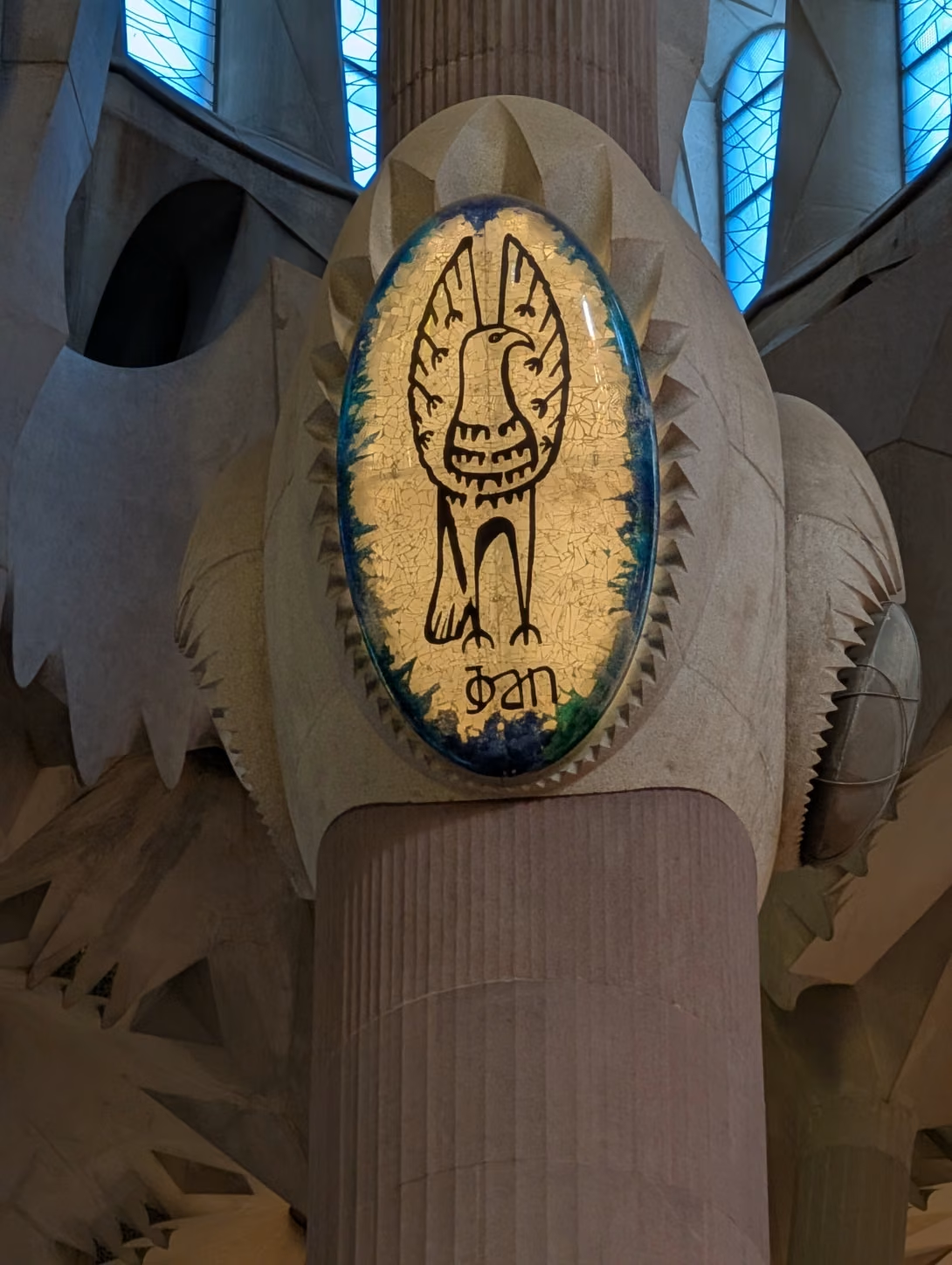
Look up at the four large porphyry columns around the crossing. Each one bears a large illuminated medallion: the tetramorph, the symbols of the four Evangelists, by the artist Domènec Fita. Their names are written in Catalan.
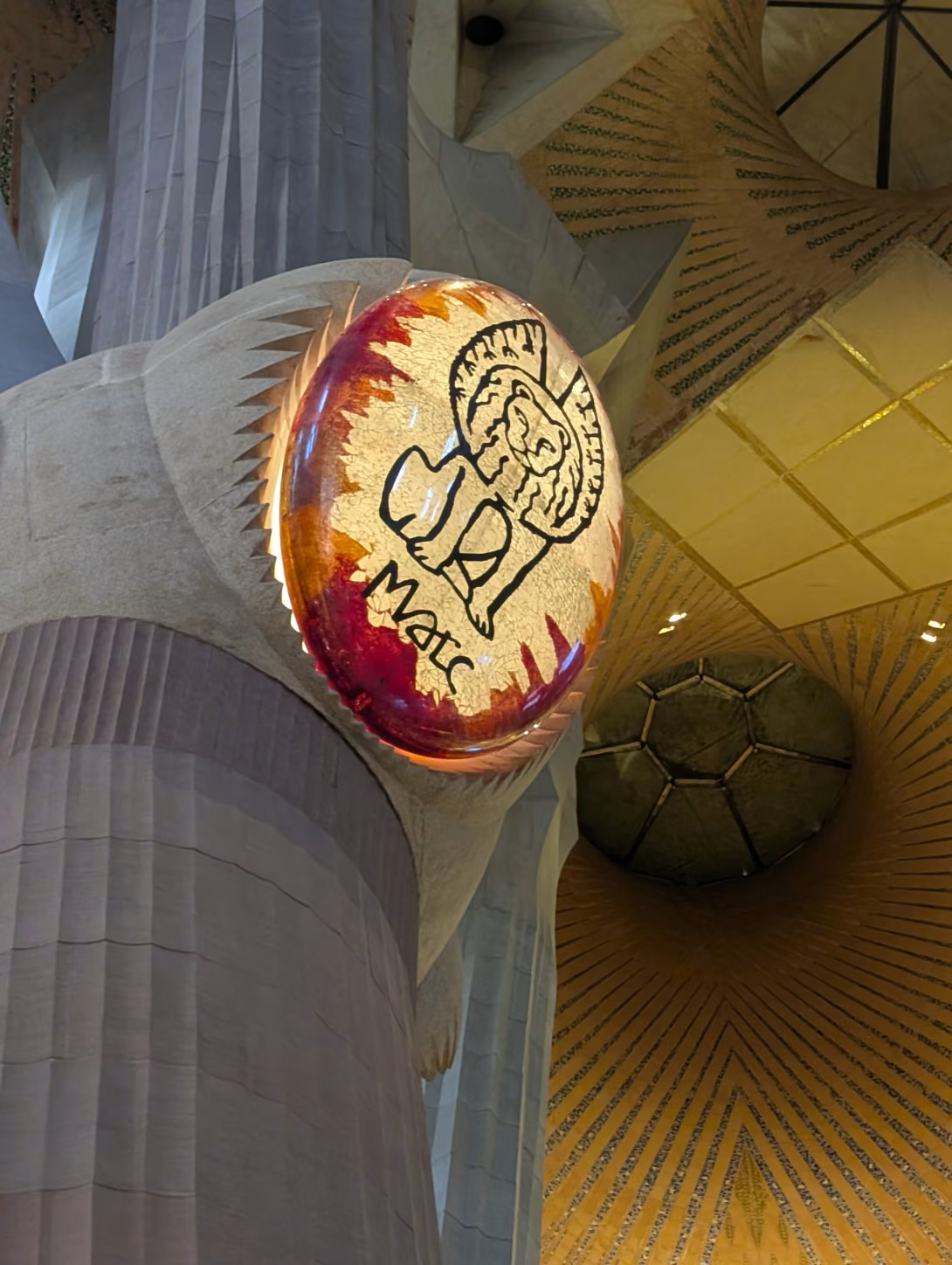
© Barcelona.com
Saint Mark, the lion
© Barcelona.com
Saint Luke, the bull
© Barcelona.com
Saint Matthew, the angel
© Barcelona.com
Saint John, the eagle
The light
The stained glass: blue in the morning, orange in the evening
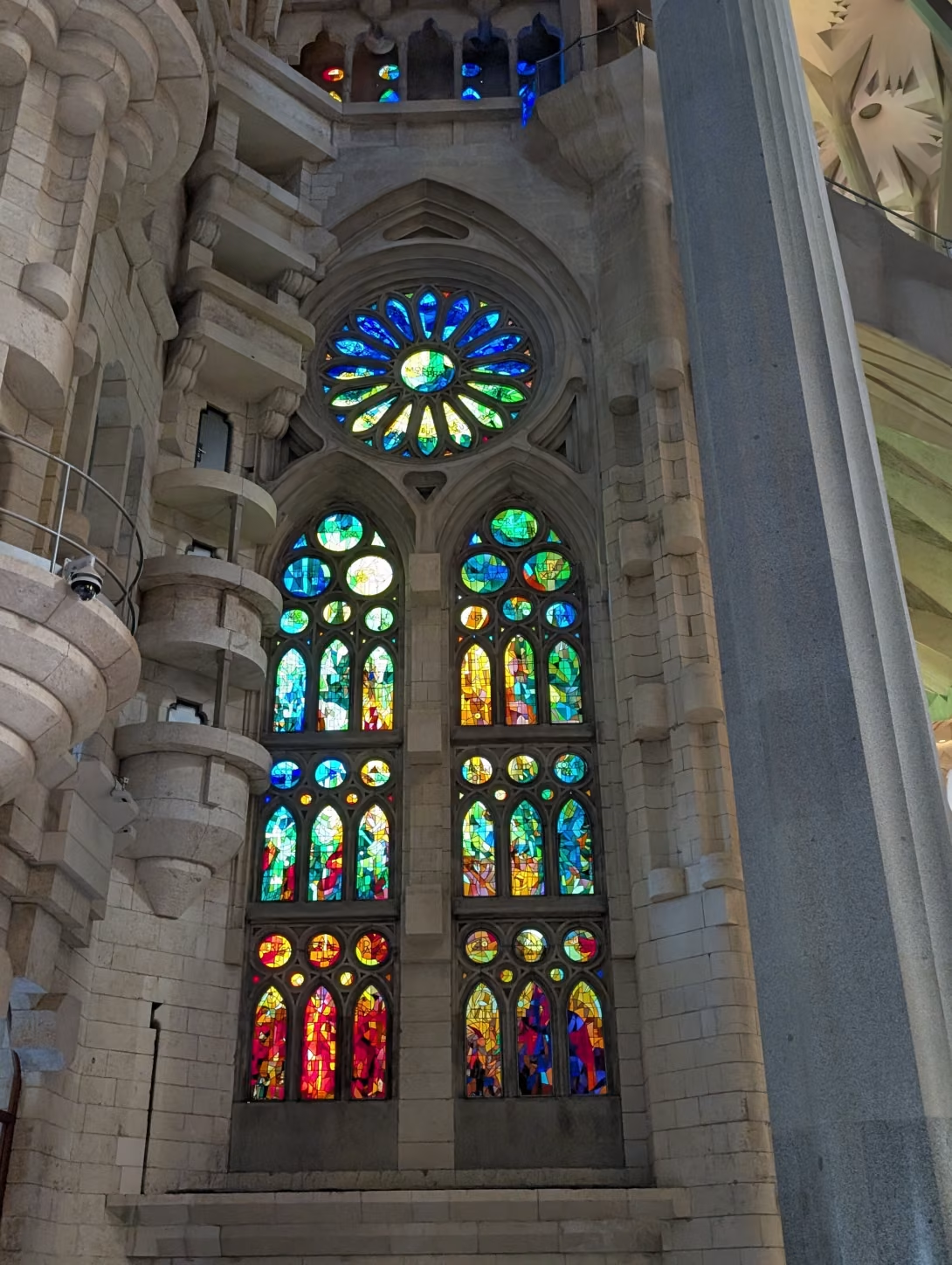
Because the vaults rest on the columns, the walls carry almost no weight, so Gaudí could open them up with large windows. The stained glass is the work of the Barcelona painter Joan Vila-Grau, who worked on it from 1999 until his death in 2022, following Gaudí's principles.
The hues follow the sun
- Nativity side, to the east: blues and greens, for the morning light.
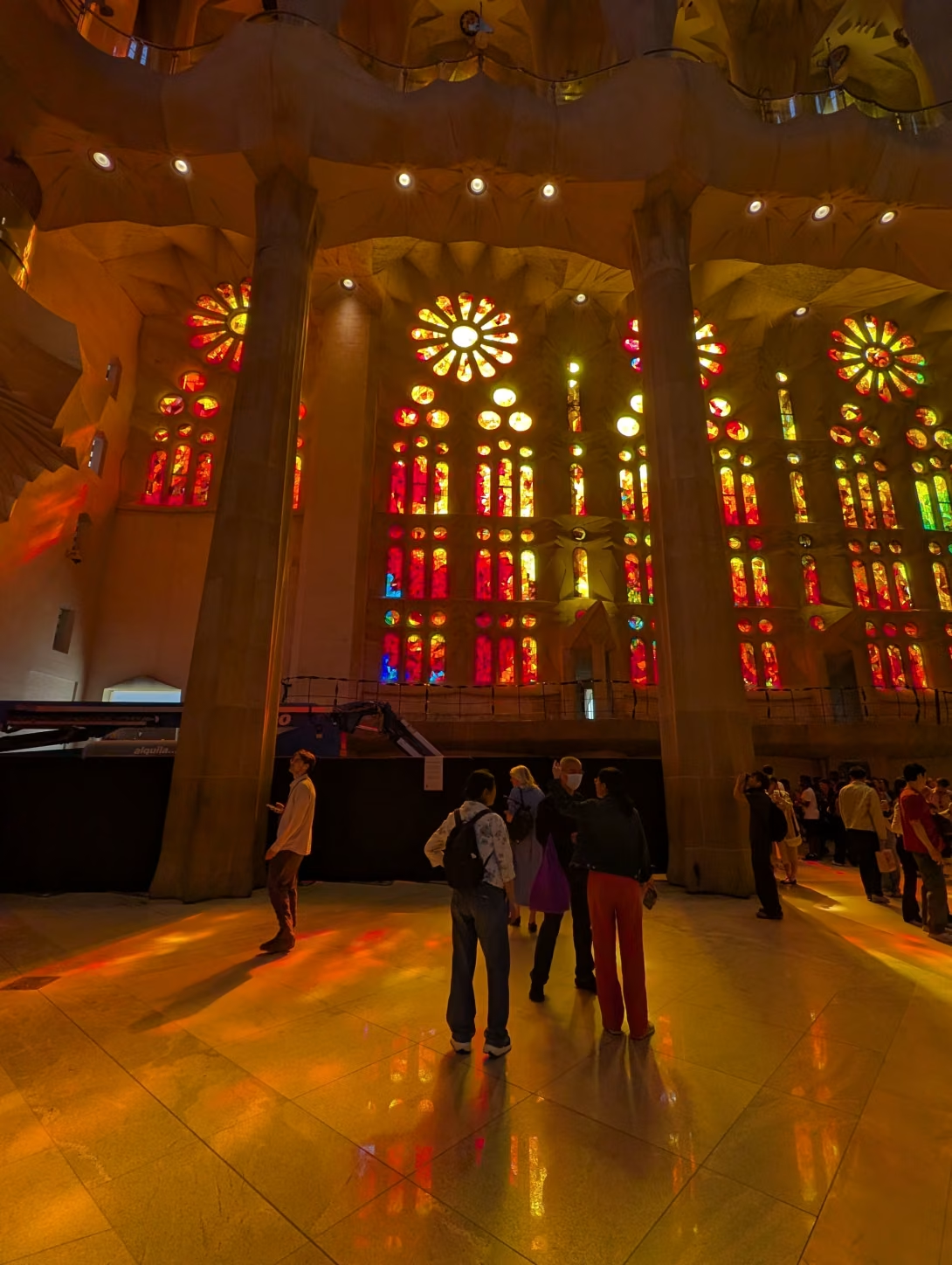
- Passion side, to the west: reds, oranges and yellows, for the evening light.
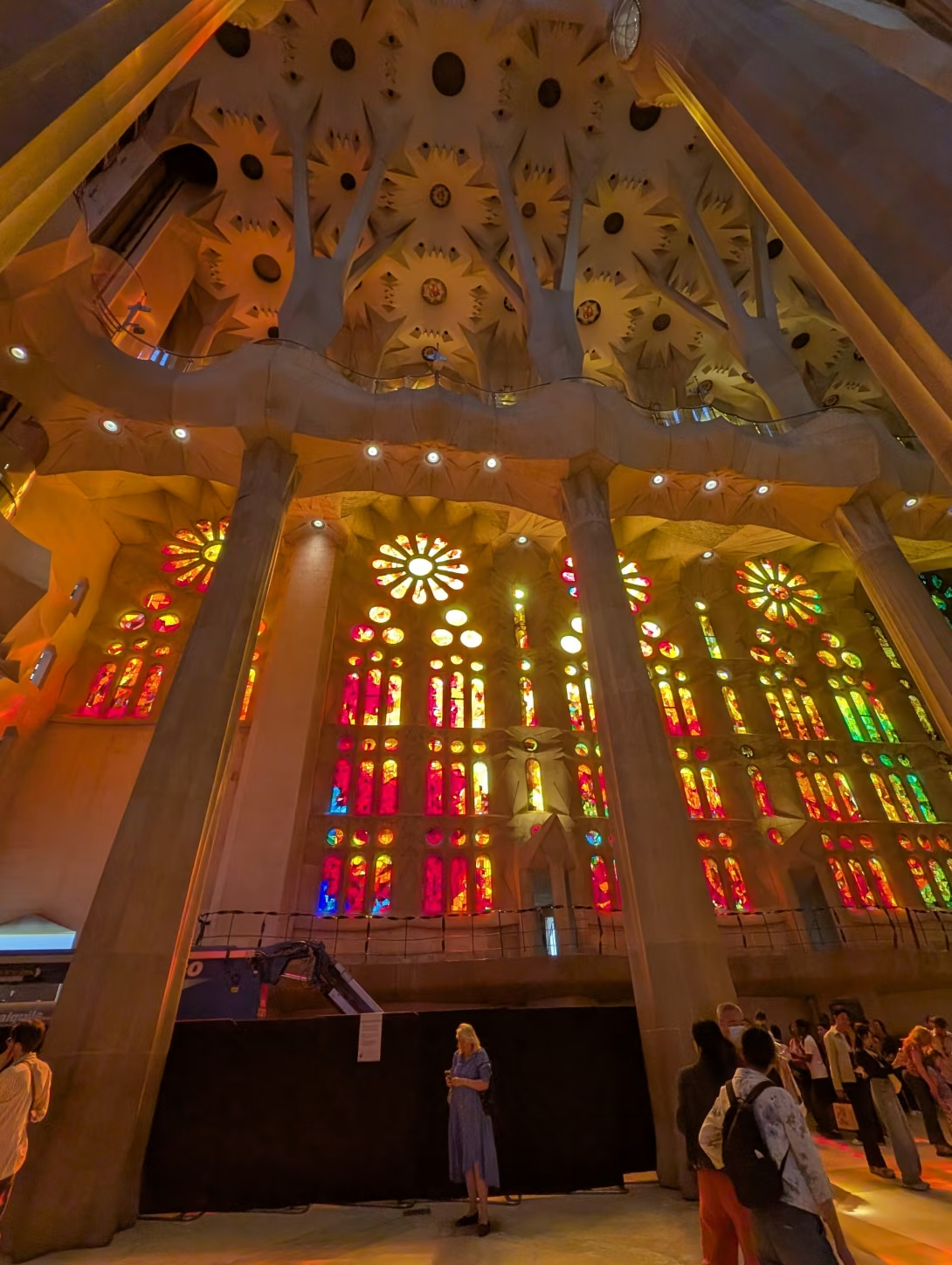
Gaudí also wanted the windows of the side aisles to be darker at the bottom and lighter at the top, up to the clear windows at the top of the central nave: the light comes from above and spreads without dazzling.
What the windows tell
They follow a precise plan. In the apse, those of the Passion transept are devoted to water, resurrection and light; those of the Nativity, to poverty, birth and life. In the naves, the lower windows bear the names of saints and, in the rose windows, of shrines in Catalonia and Spain. The upper ones evoke the parables of Jesus.
When to come for the light
In the morning, the nave is bathed in bluish light. In the late afternoon, the sun shines through the Passion windows and casts red and orange onto the columns and the floor. If you can choose your time slot, late in the day is the most spectacular.
In the stained glass
Names written in light
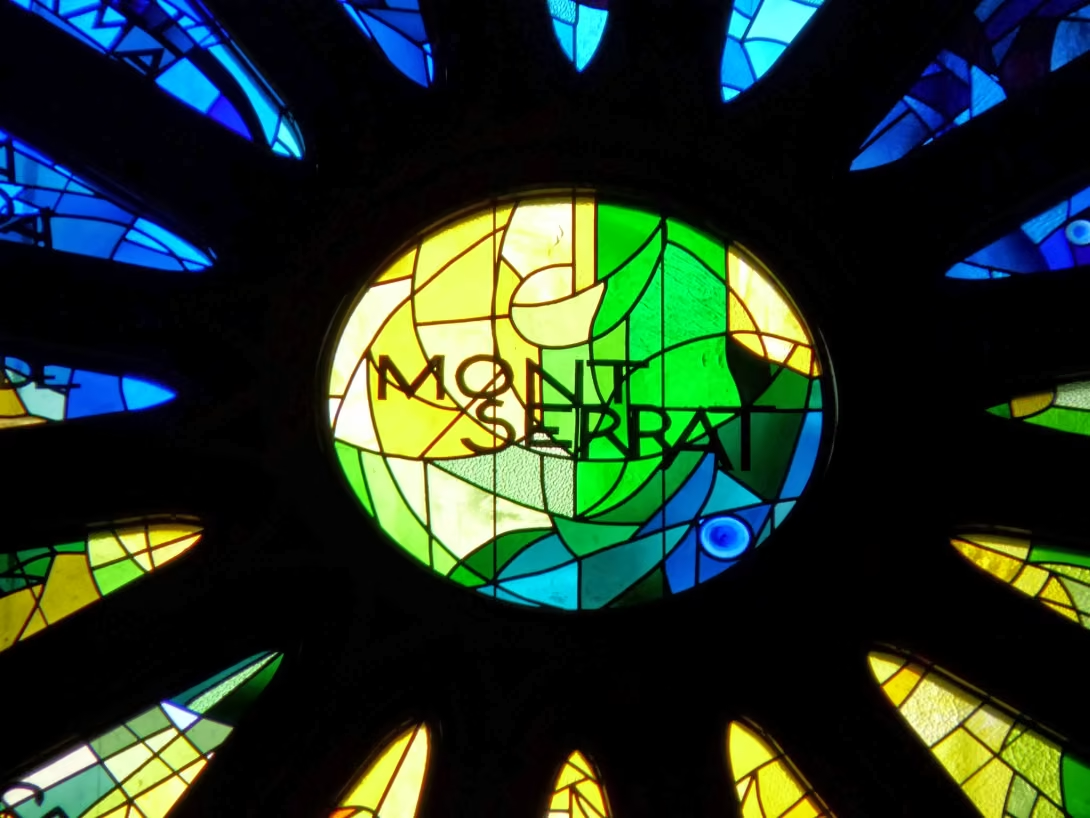
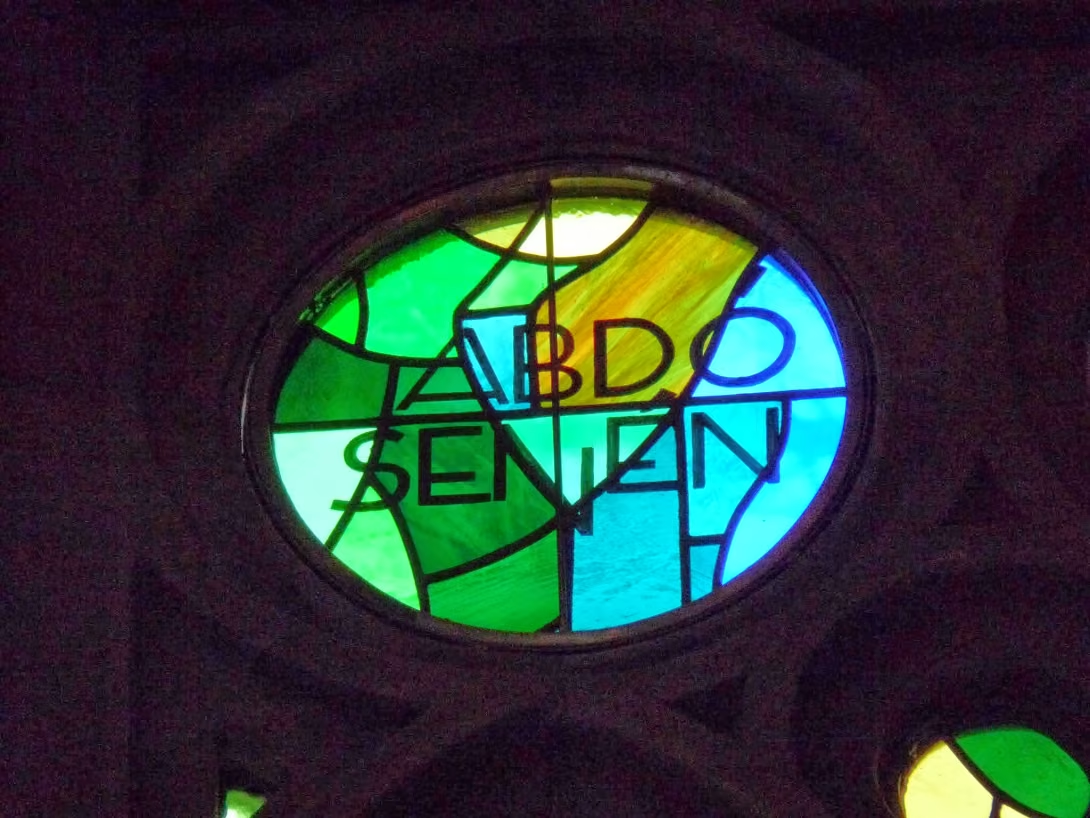
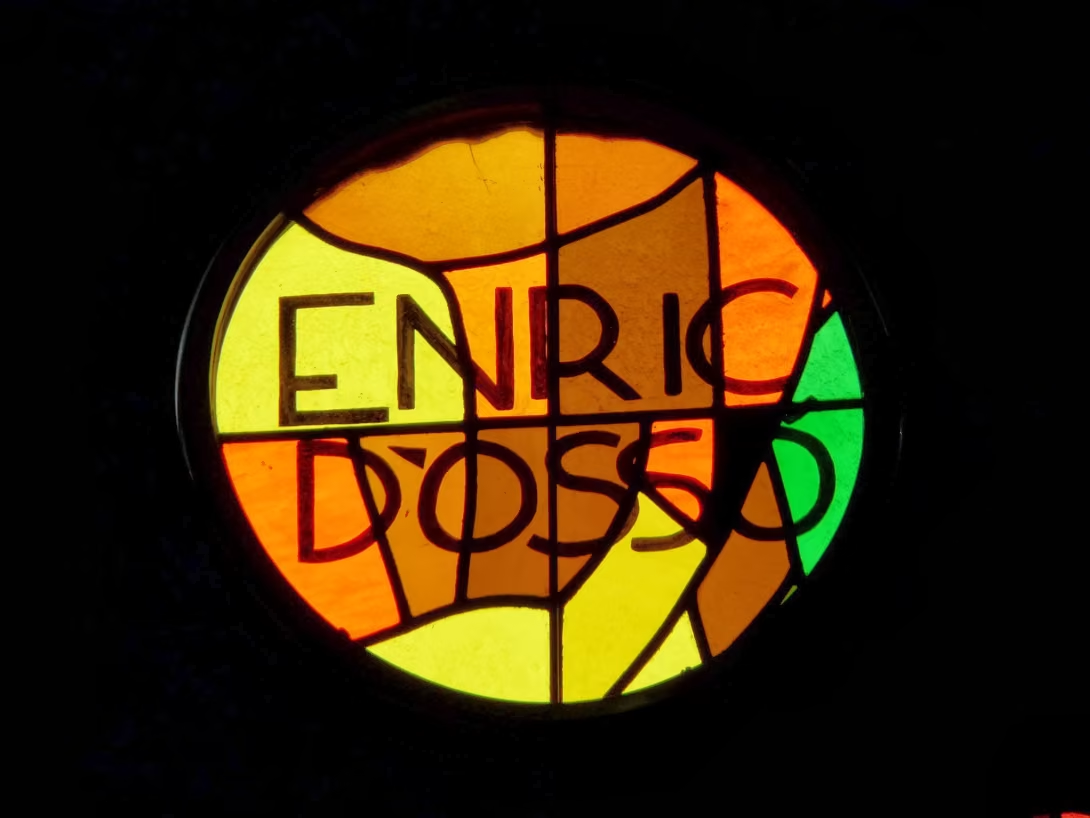
Look up at the small round windows: each one bears a name, that of a saint or a shrine. Here are three.
© Barcelona.com
Montserrat
© Barcelona.com
Abdó and Senén
© Barcelona.com
Enric d'Ossó
The chancel
The apse, the altar and the baldachin
The apse is the most important part of the church: it is where the altar stands. At the Sagrada Família, it is crowned by the highest vault of the interior, at 75 m, and, outside, by the Tower of the Virgin Mary.
The altar and the Christ
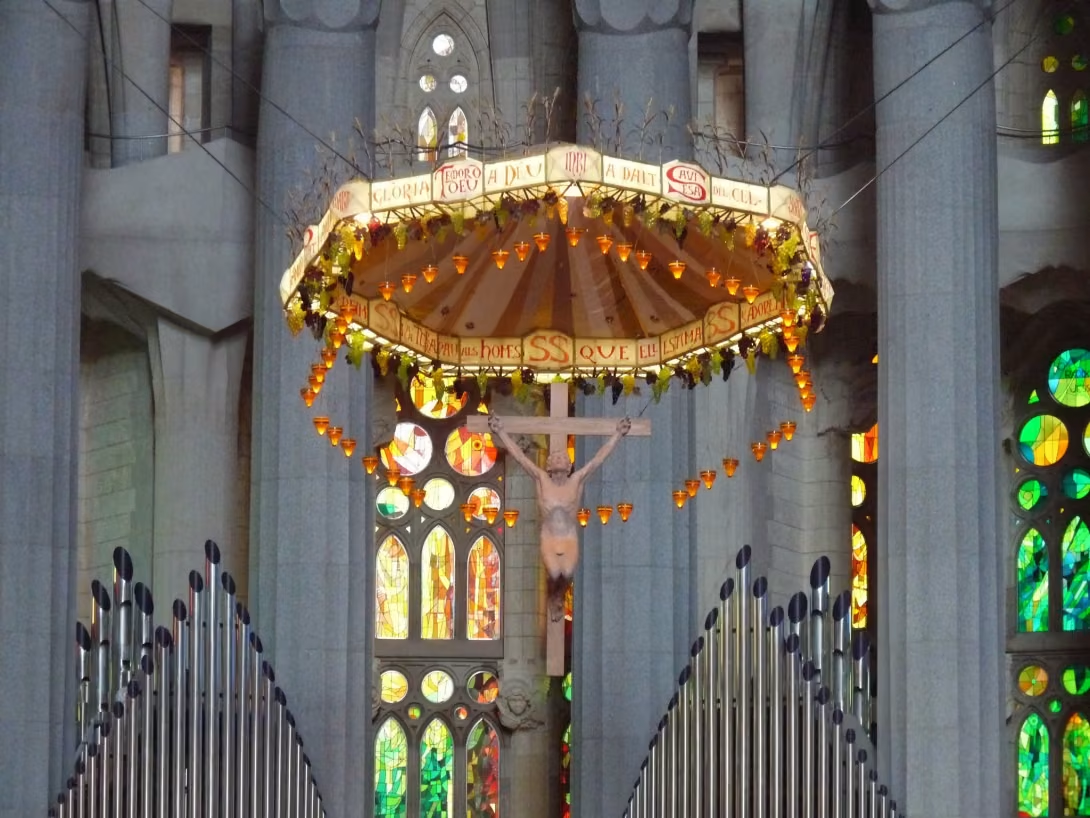
The altar stands on the presbytery, a platform raised 2 m and surrounded by ten columns. It is a block of porphyry 2.72 m long that weighs 7.5 tonnes. Above it hangs a terracotta Christ on the cross, sculpted by Francesc Fajula and inspired by the small Christ that Gaudí had commissioned for the chapel of Casa Batlló.
The baldachin
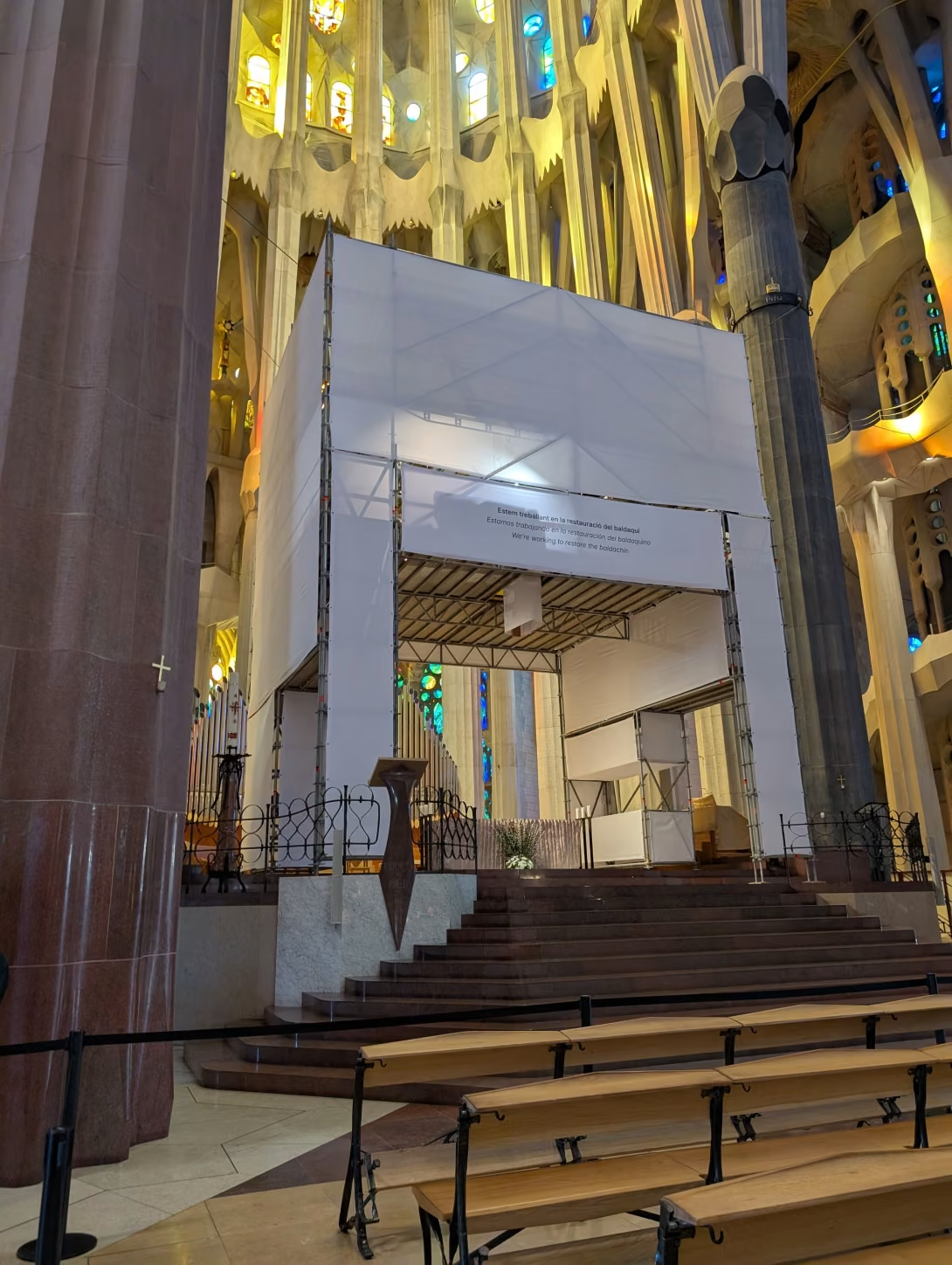
The Christ hangs from a heptagonal baldachin 5 m in diameter, based on the one Gaudí designed for Mallorca Cathedral. It is decorated with glass grapes and vine leaves and with ears of wheat in white wood, symbols of communion. Its seven sides bear the names of the seven gifts of the Holy Spirit and the words of the Gloria. It holds 50 lamps: seven on each side and one in the middle.
Around the altar
- The organ, built by the Blancafort workshop, is in the presbytery.
- The mosaic of the apse vault, in gilded glass, represents the Trinity as a golden triangle, at the foot of the large central skylight.
- The seven apse chapels surround it. The Chapel of the Blessed Sacrament, in the middle, is the quietest place for prayer.
- The choir galleries run all around the basilica, 15 to 20 m up, so that singing fills the space. Their balustrades bear Gregorian chant scores.
The Holy Family
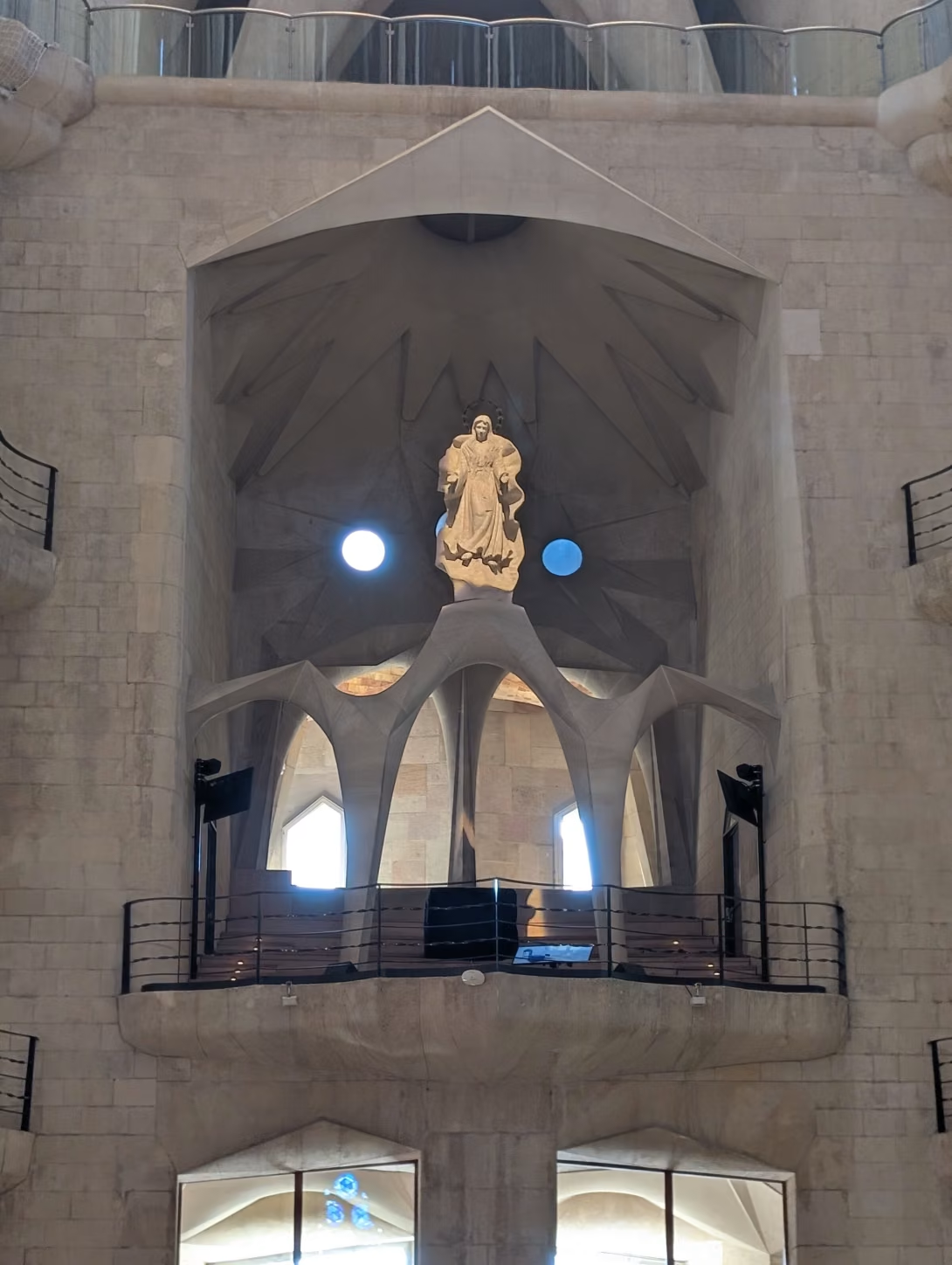
It is depicted three times: Christ above the altar, the Virgin Mary on the gallery above the central door on the Passion side, and Saint Joseph above the door on the Nativity side. These two statues are by the sculptor Ramon Cuello. In the middle of the crossing, a ceramic inlay in the floor bears the initials JMJ, for Jesus, Mary and Joseph.
Beneath the apse
The crypt and Gaudí's tomb
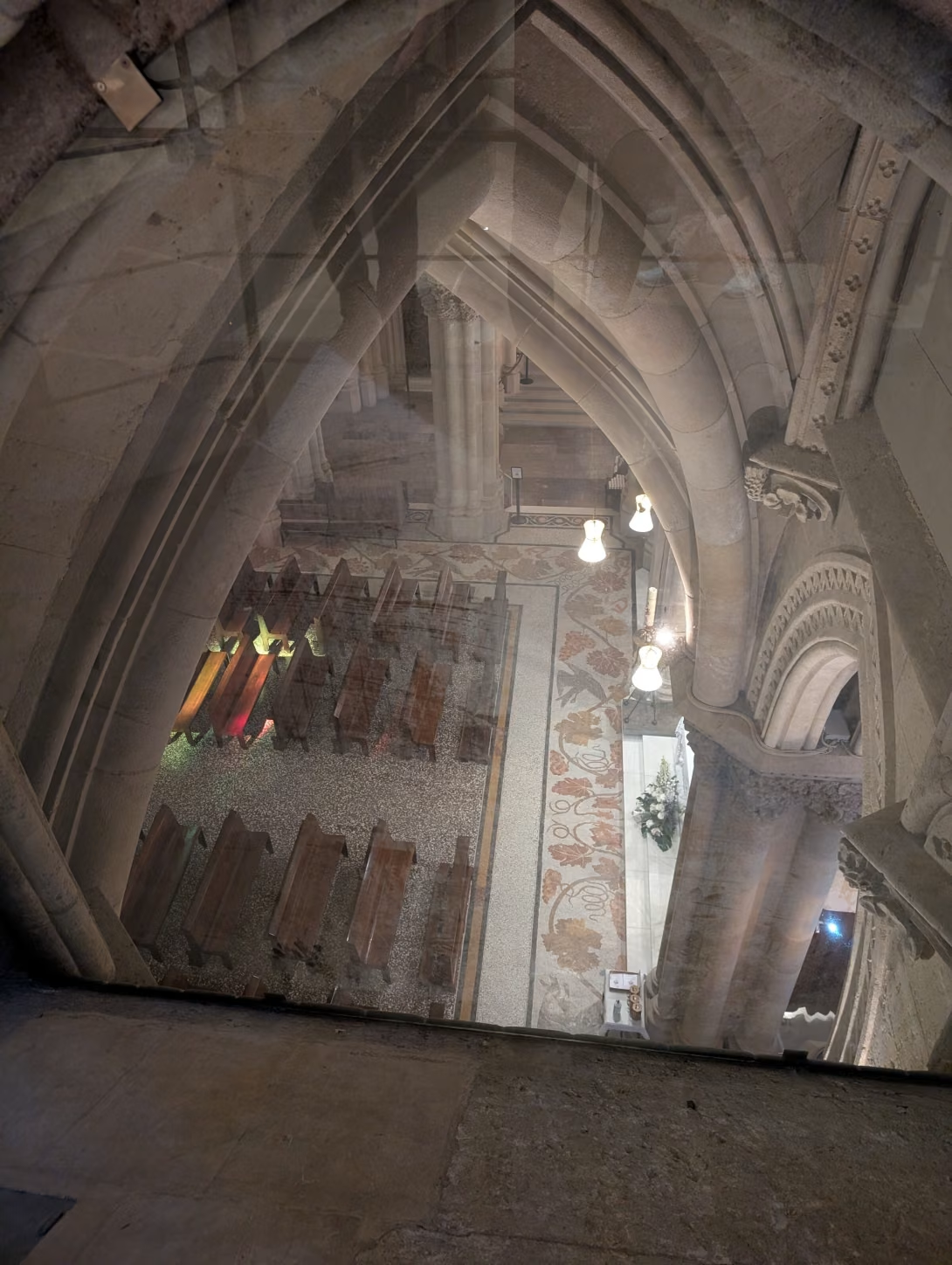
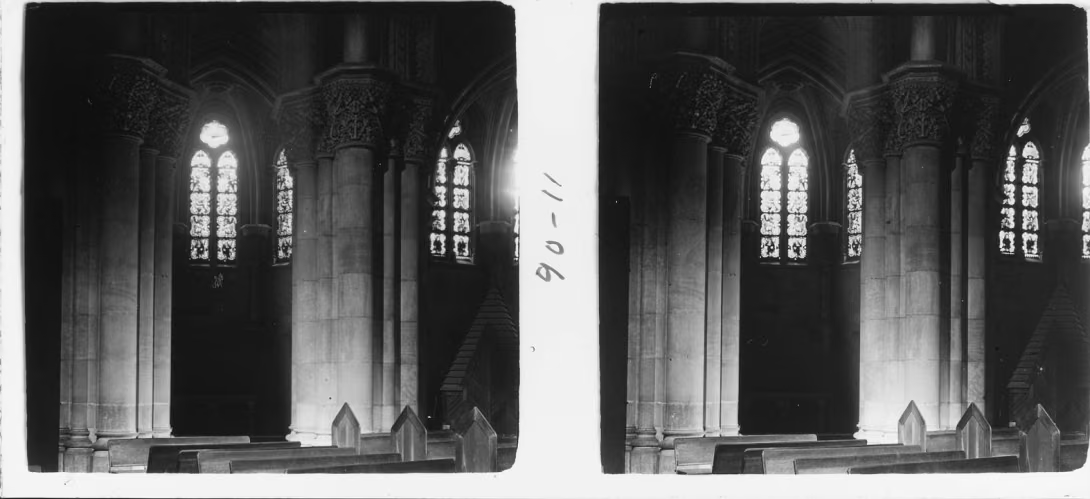
The crypt is the oldest part of the basilica. It was begun in 1882, to the neo-Gothic plans of Francisco de Paula del Villar, then completed by Gaudí. It lies directly beneath the apse, whose semicircular plan it shares; large spiral staircases connect the two. The first Masses were celebrated here, and it is still a church where Mass is said.
Antoni Gaudí has been buried here since his death in 1926. The crypt is a UNESCO World Heritage Site together with the Nativity façade. During the visit, you see it from above, from the museum, through a glazed opening: the crypt is not included in the ticket. You can go in for the parish Masses, held every day.
Understanding the construction
The museum and the Schools
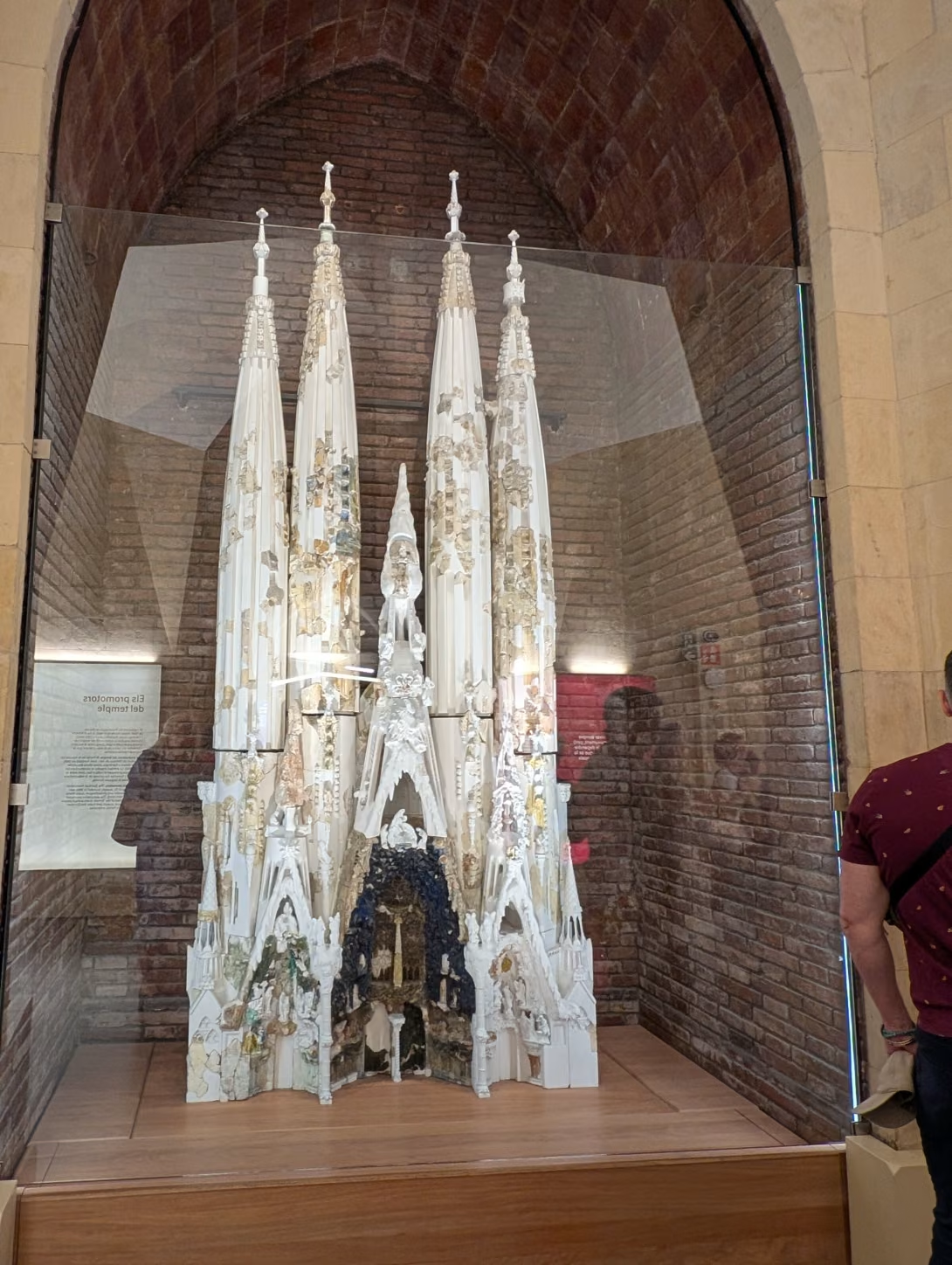
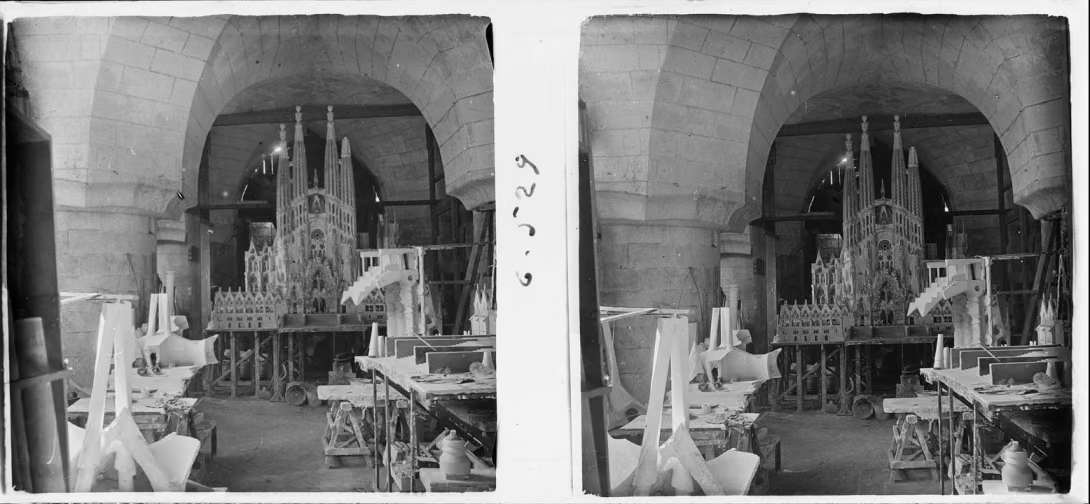
Located under the basilica, the museum tells the story of the construction since 1882: plans, archive photographs, plaster models rebuilt after the fire in Gaudí's workshop in 1936, and a reproduction of his funicular model, made of strings and hanging weights, which he used to find the shape of the arches. A large illuminated timeline sums up 140 years of construction. The official website recommends ending the visit with the museum.
Near the Passion façade, the small Sagrada Família Schools building was built by Gaudí in 1909 for the workers' children and local children; he paid for the work himself. Its undulating brick walls and roof left their mark on architects such as Le Corbusier. In 2002, the building was taken down and rebuilt at the corner of Carrer de Sardenya and Carrer de Mallorca, to free the site of the future Glory façade.
Gallery
Inside the Sagrada Família in pictures
Our photos of the visit, in the order of the route. Click to enlarge.
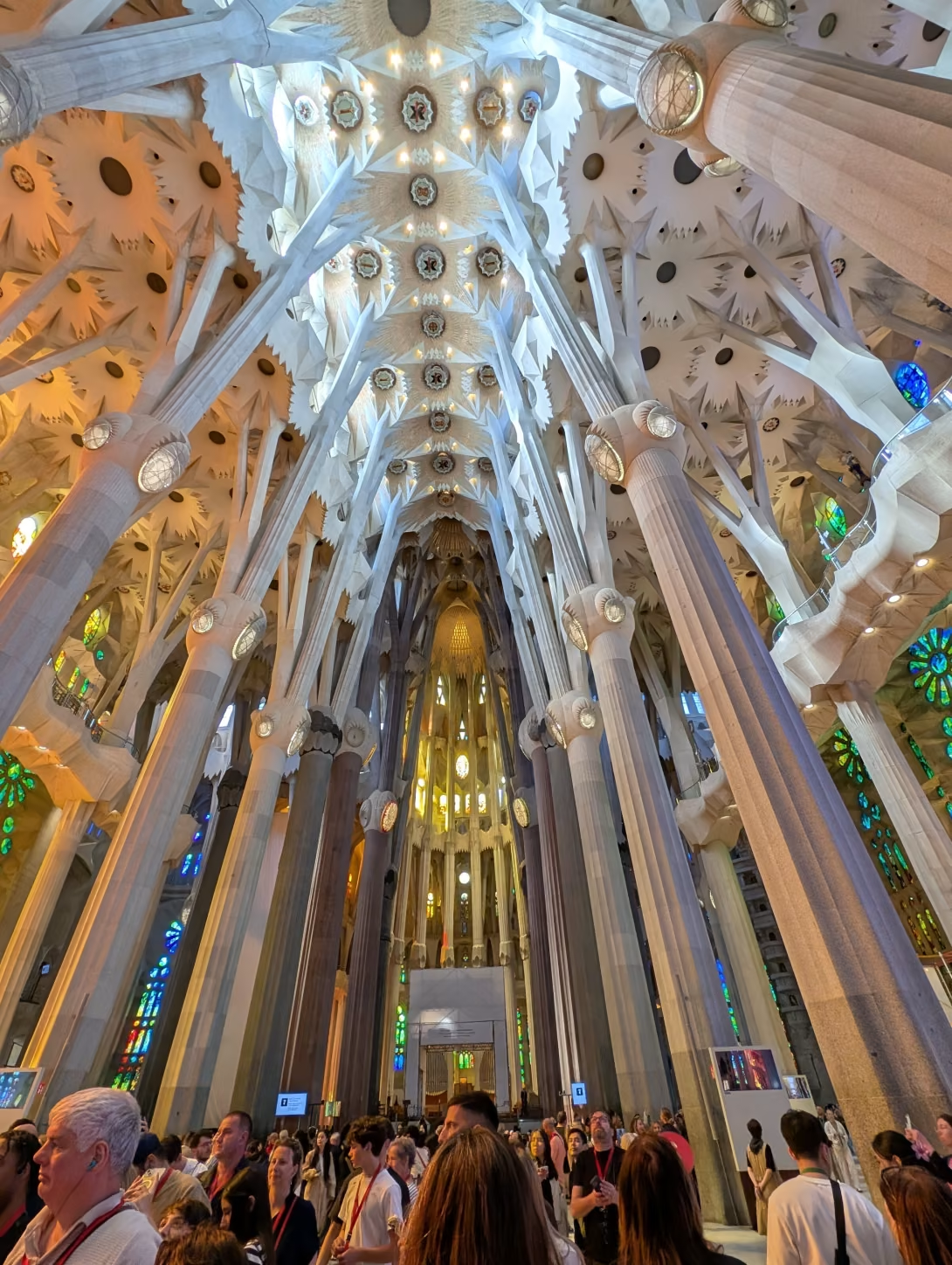
The central nave of the Sagrada Família looking towards the apse, with the tree-like columns and crowds of visitors
© Barcelona.com
Columns of the Sagrada Família branching out beneath the vault, in front of blue stained glass windows
© Barcelona.com
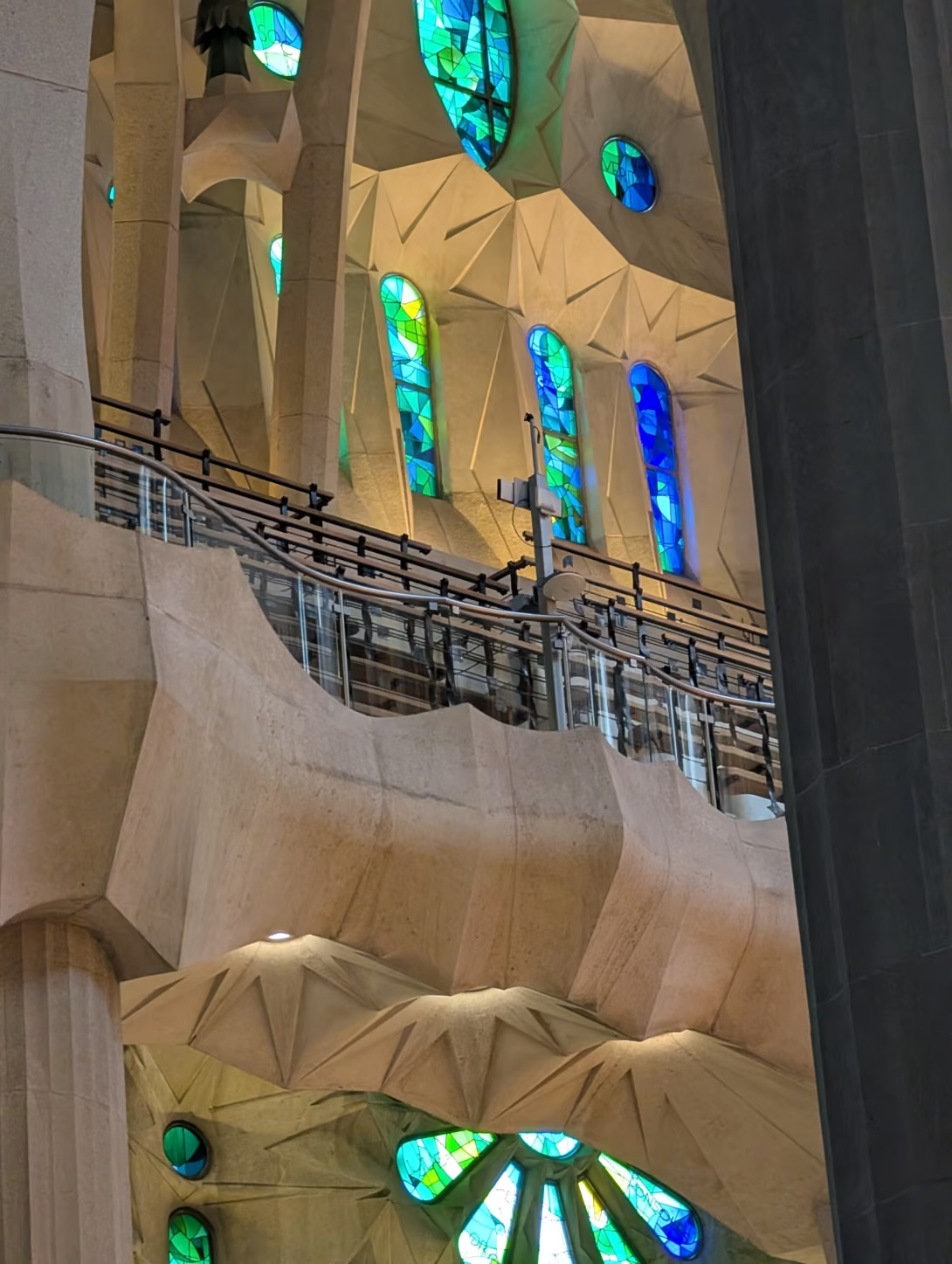
A gallery with undulating forms, edged with a railing, beneath blue and green stained glass windows in the Sagrada Família
© Barcelona.com
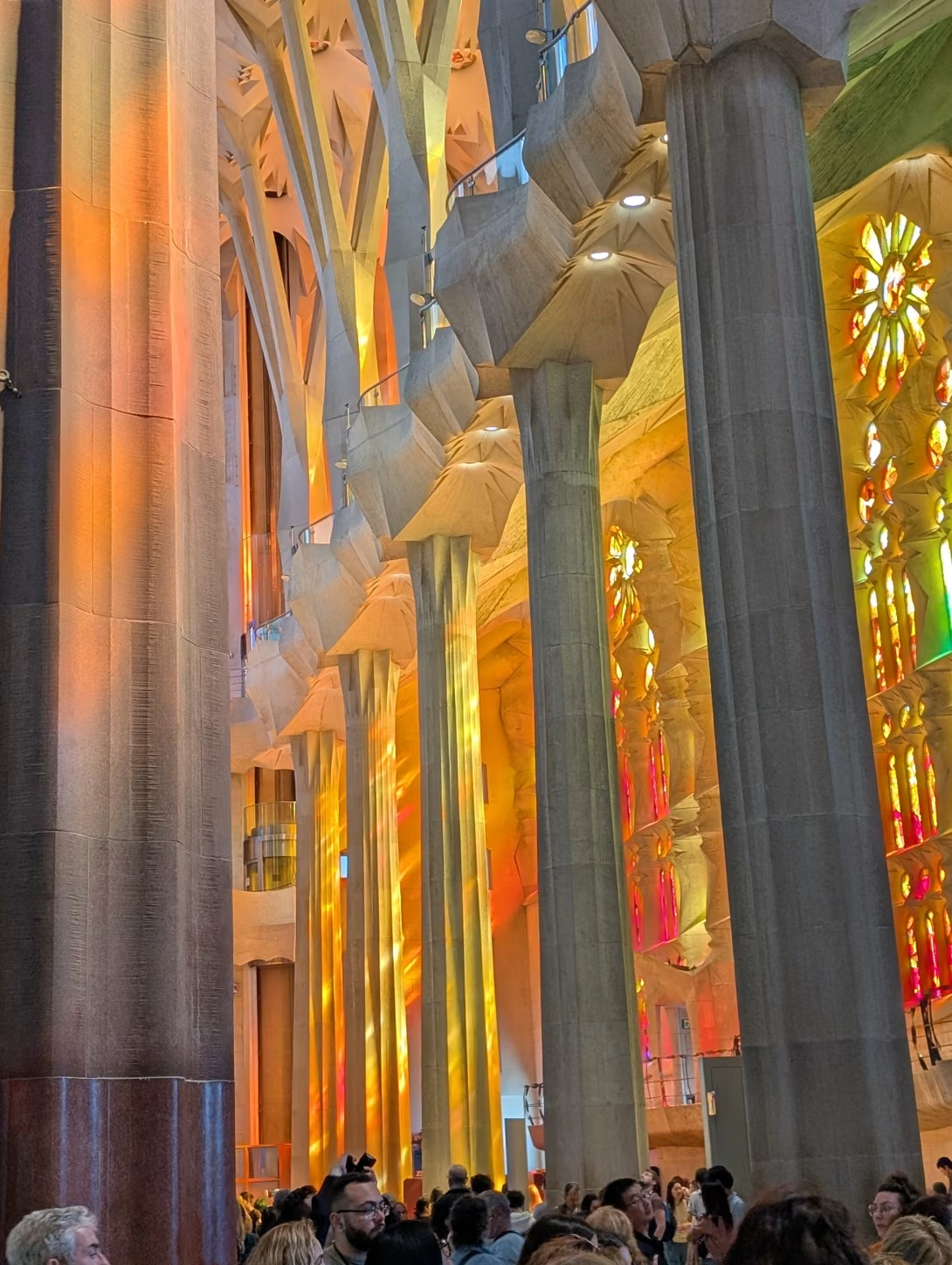
Columns of the Sagrada Família bathed in orange light from the stained glass windows
© Barcelona.com
Medallion of the winged lion of Saint Mark, inscribed Marc, on a crossing column of the Sagrada Família
© Barcelona.com
Medallion of the winged bull of Saint Luke, inscribed Lluc, on a crossing column of the Sagrada Família
© Barcelona.com
Medallion of the angel of Saint Matthew, inscribed Mateu, on a crossing column of the Sagrada Família
© Barcelona.com
Medallion of the eagle of Saint John, inscribed Joan, on a crossing column of the Sagrada Família
© Barcelona.com
Looking up at the crossing of the Sagrada Família: the columns converge towards the luminous vault
© Barcelona.com
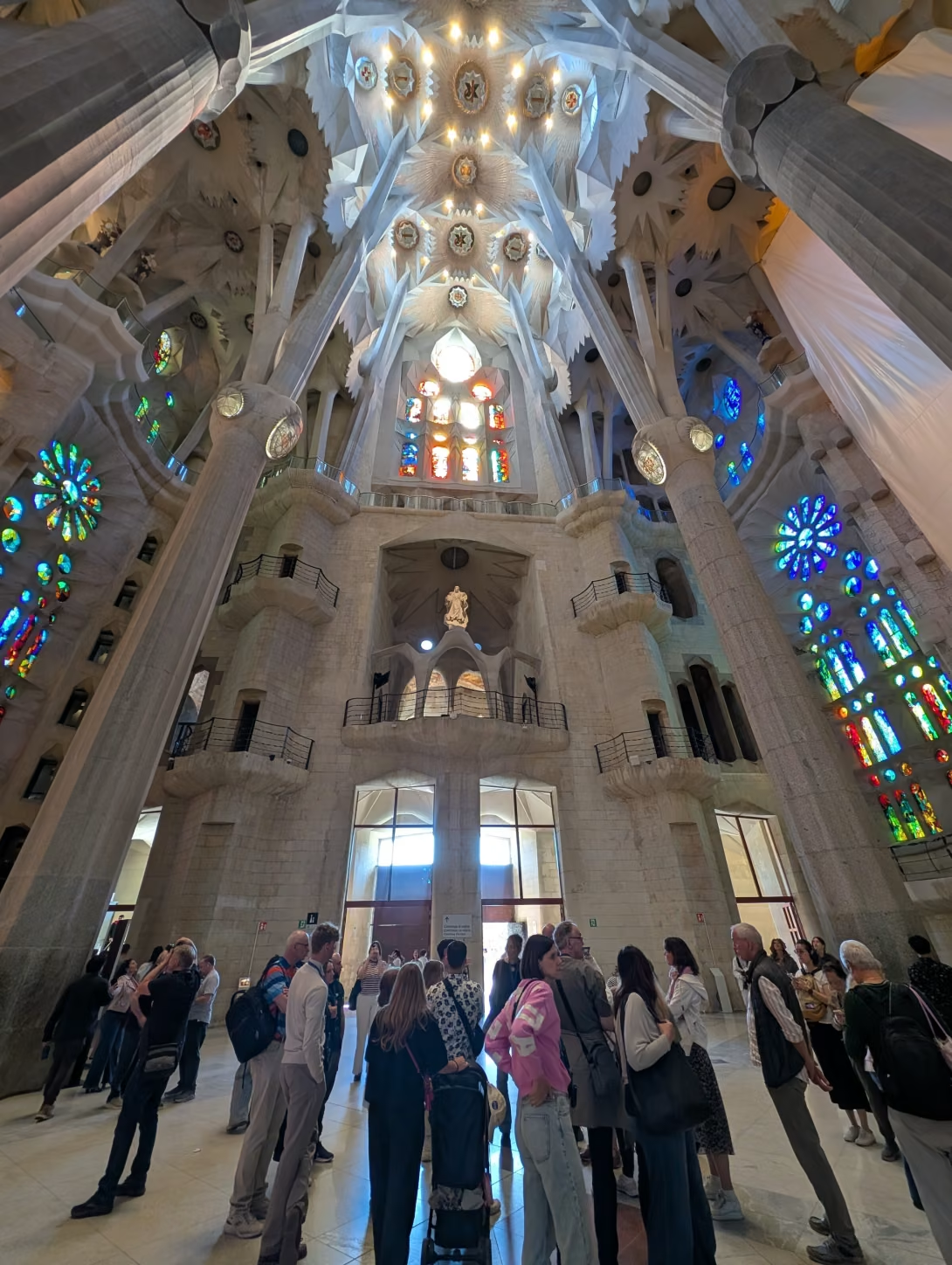
The apse of the Sagrada Família surrounded by columns and rose windows, with visitors
© Barcelona.com
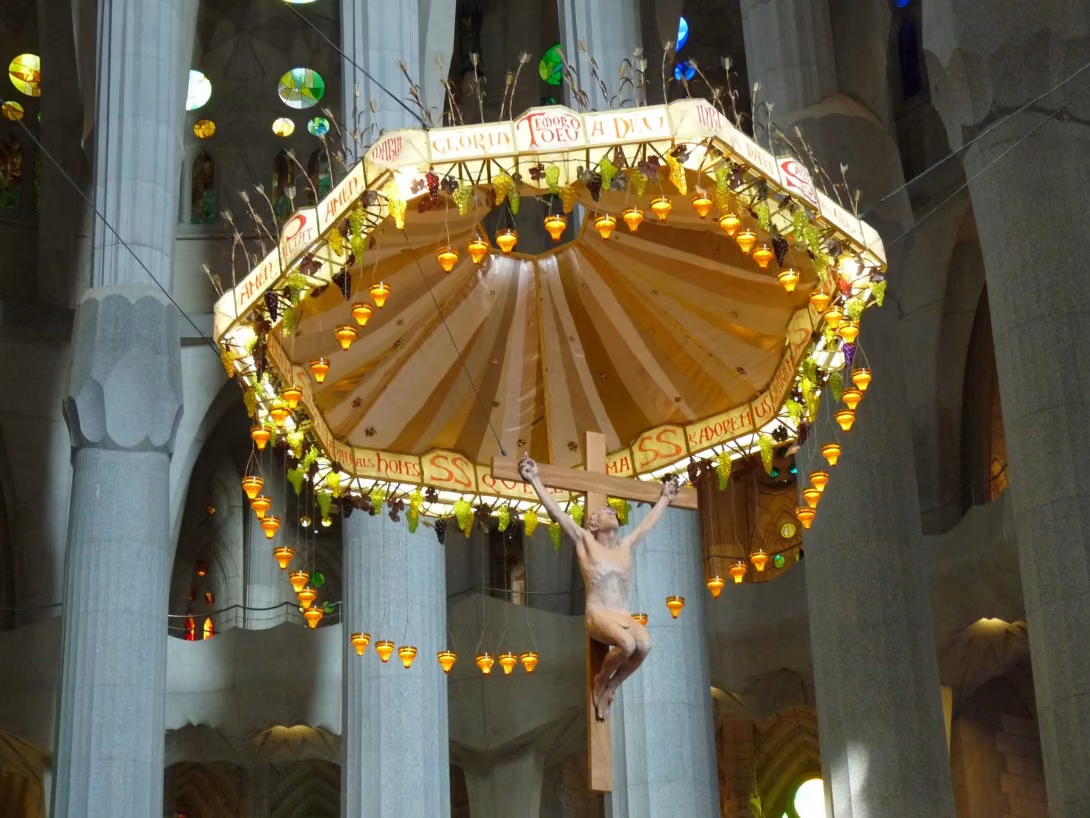
The baldachin decorated with bunches of grapes, ears of wheat and lamps, and Christ on the cross, suspended above the altar of the Sagrada Família
© Barcelona.com
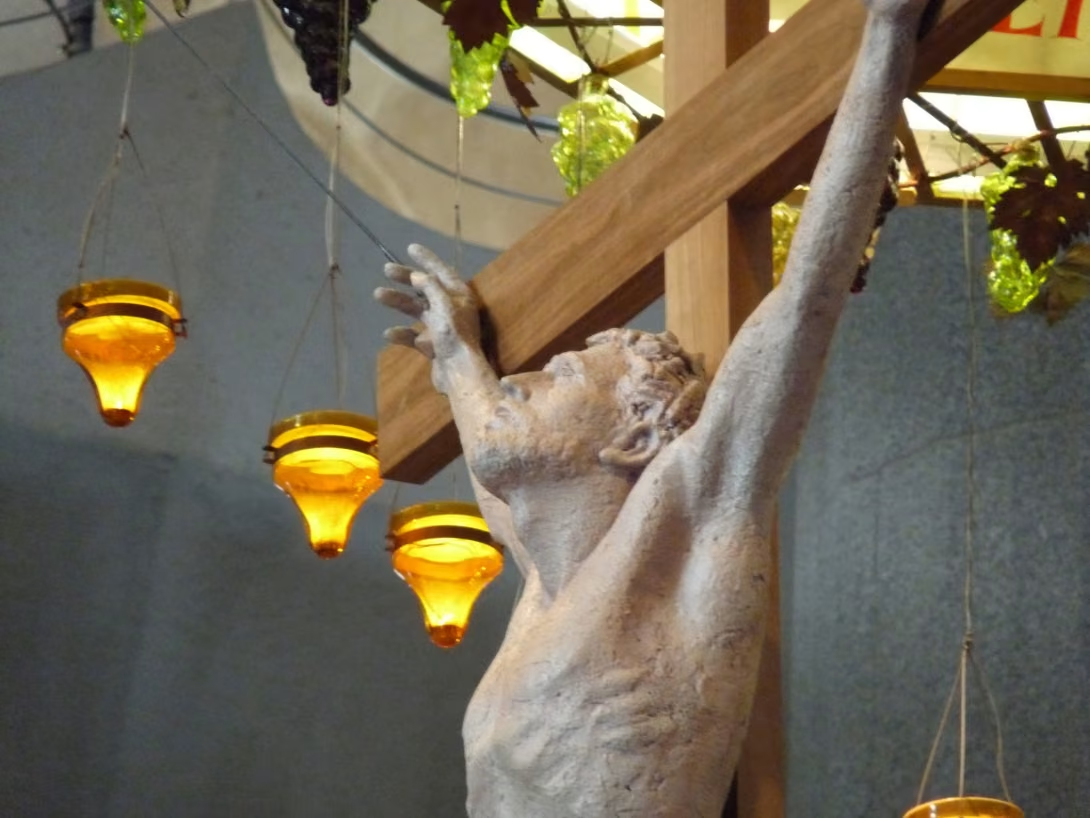
Close-up of Christ on the cross suspended beneath the baldachin, with its lamps, in the Sagrada Família
© Barcelona.com
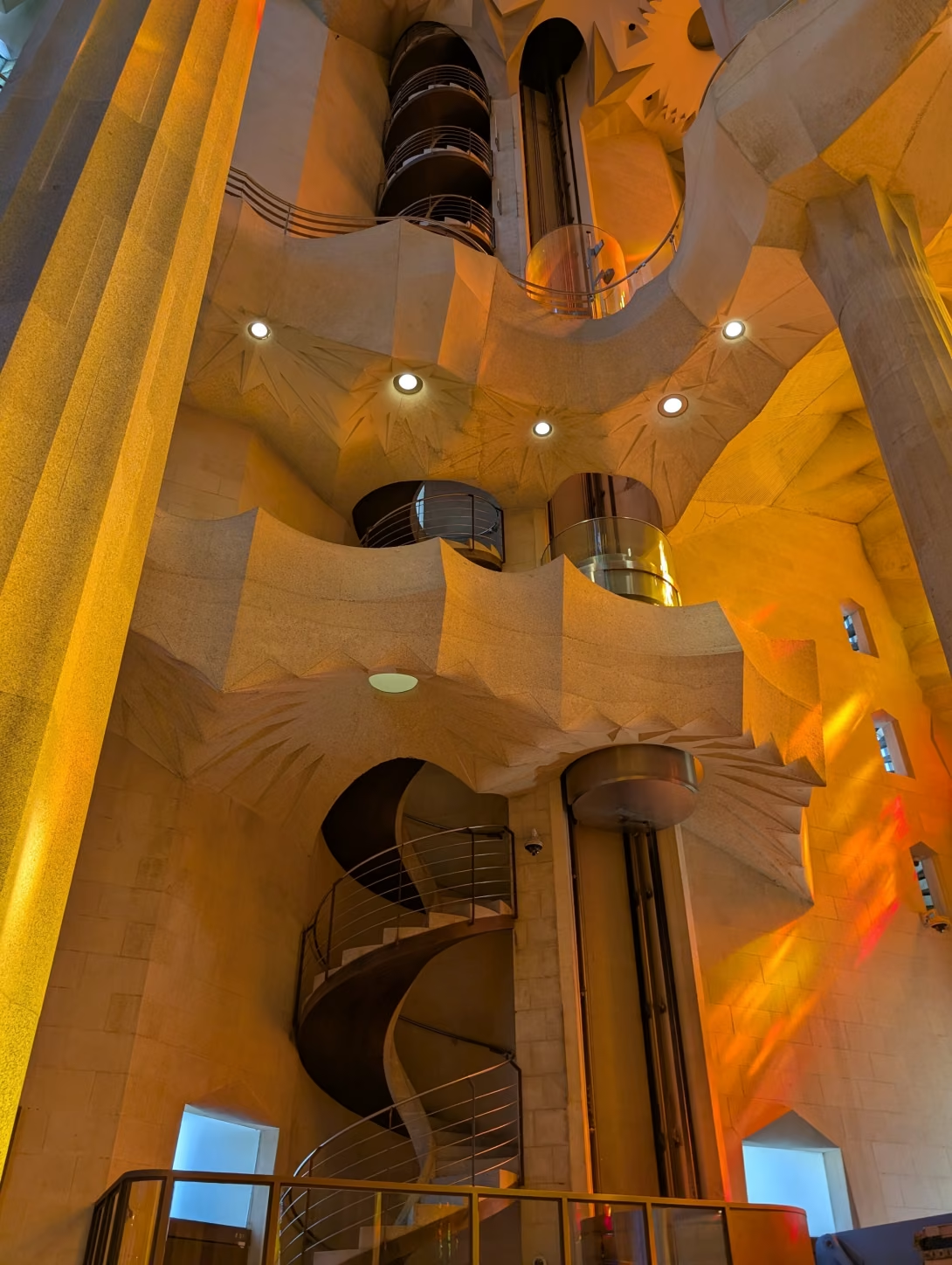
Spiral staircase in a tower of the Sagrada Família, bathed in orange light
© Barcelona.com
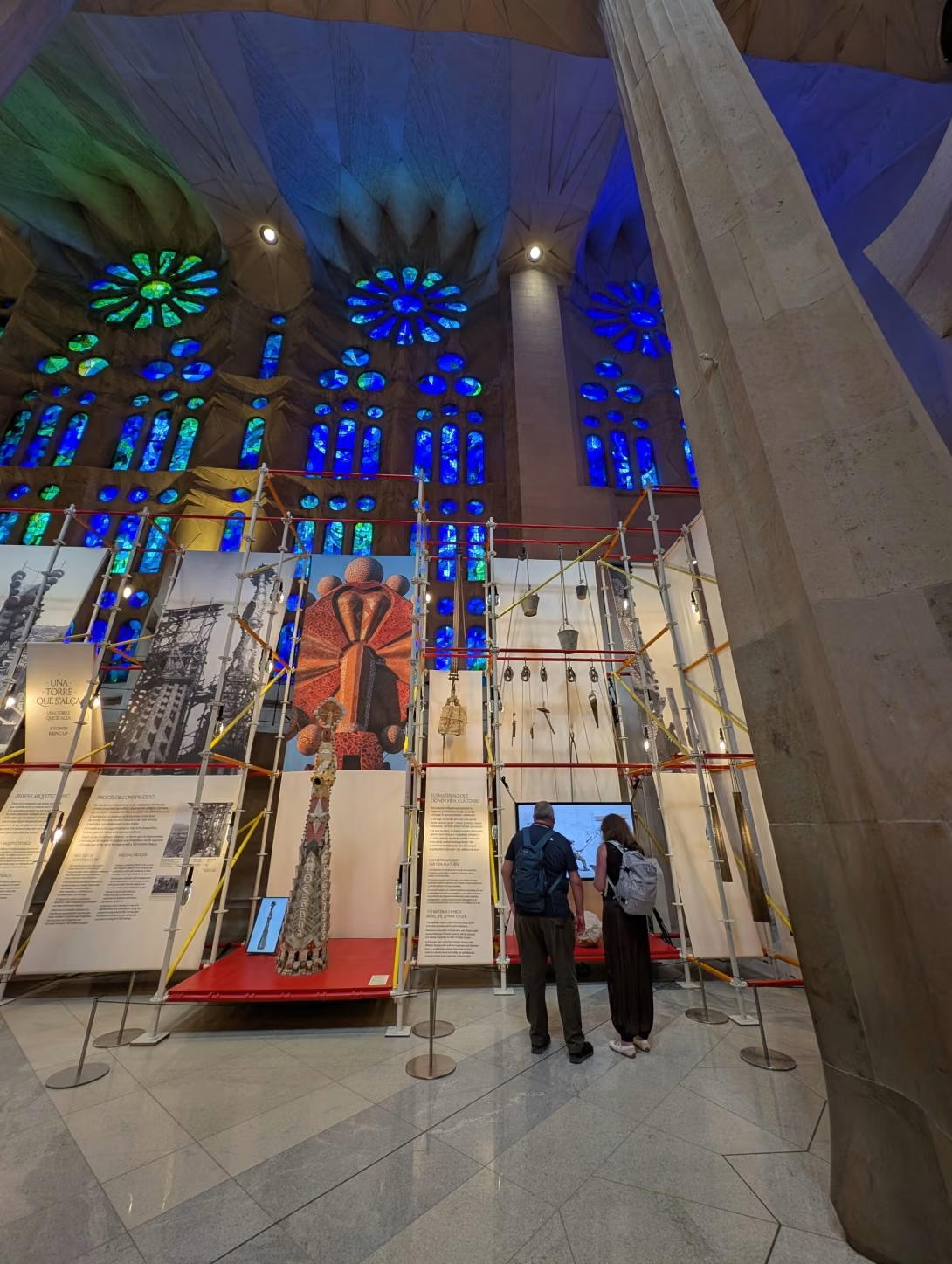
Two visitors in front of exhibition panels and a model of a colourful pinnacle, beneath the blue and green stained glass windows of the Sagrada Família
© Barcelona.com

Vaulted corridor of the Sagrada Família museum, with panels and visitors
© Barcelona.com
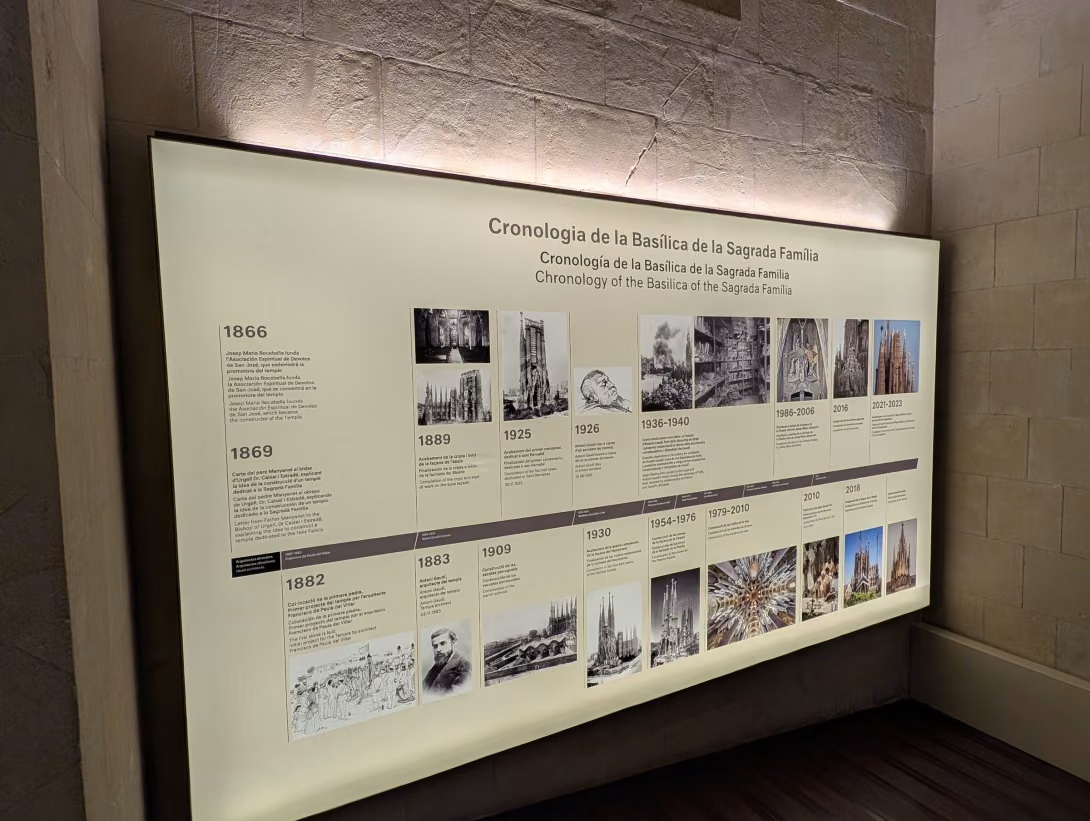
Illuminated timeline of the construction of the Sagrada Família, with archive photos, in the museum
© Barcelona.com
Gallery
Details to look for during your visit
Texts on the bronze doors, patterns in the floor, numbers in the stone: what you miss the first time round. Click to enlarge.
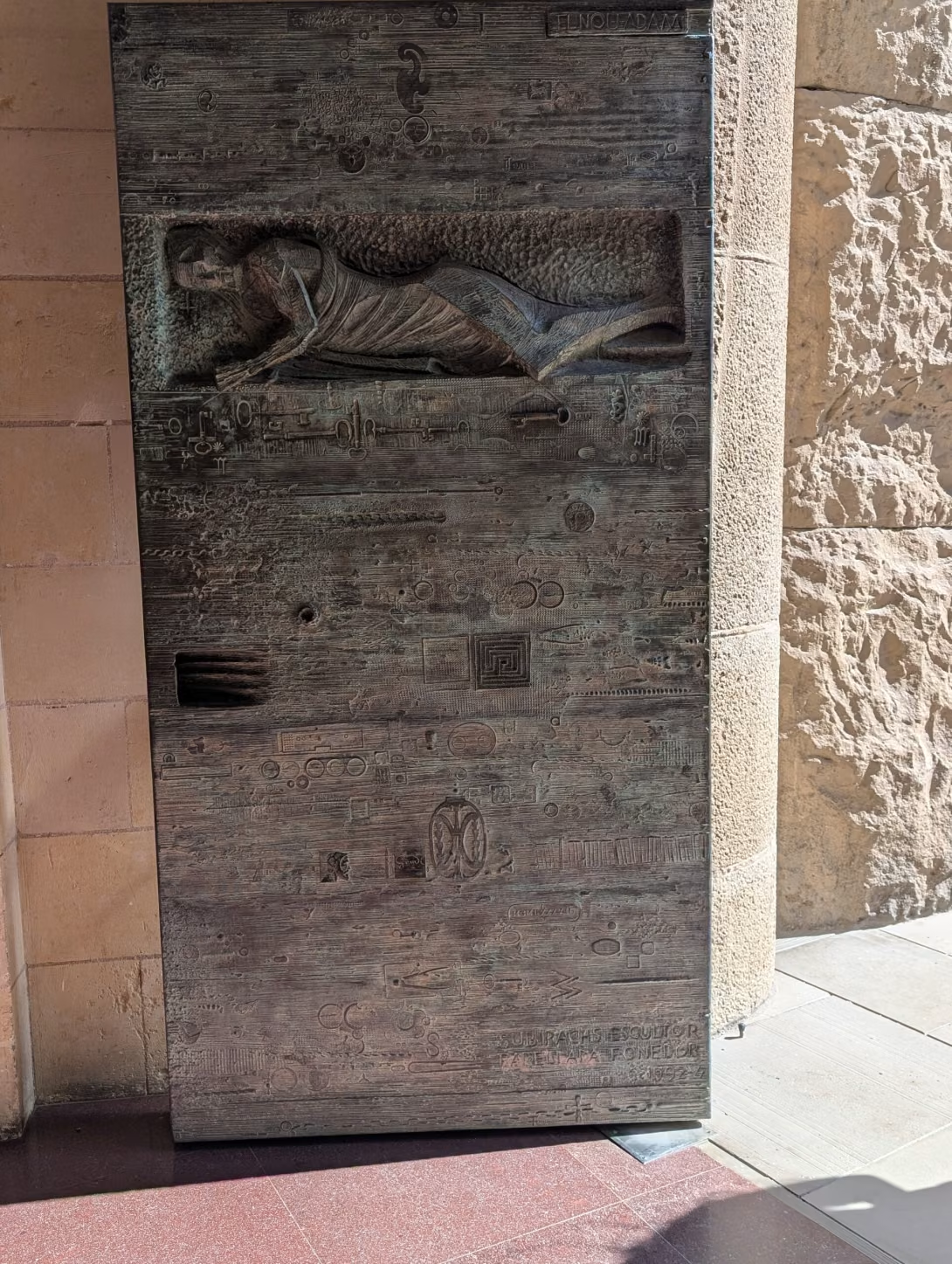
Bronze door of the Sagrada Família: a reclining figure sculpted in relief above an engraved text
© Barcelona.com
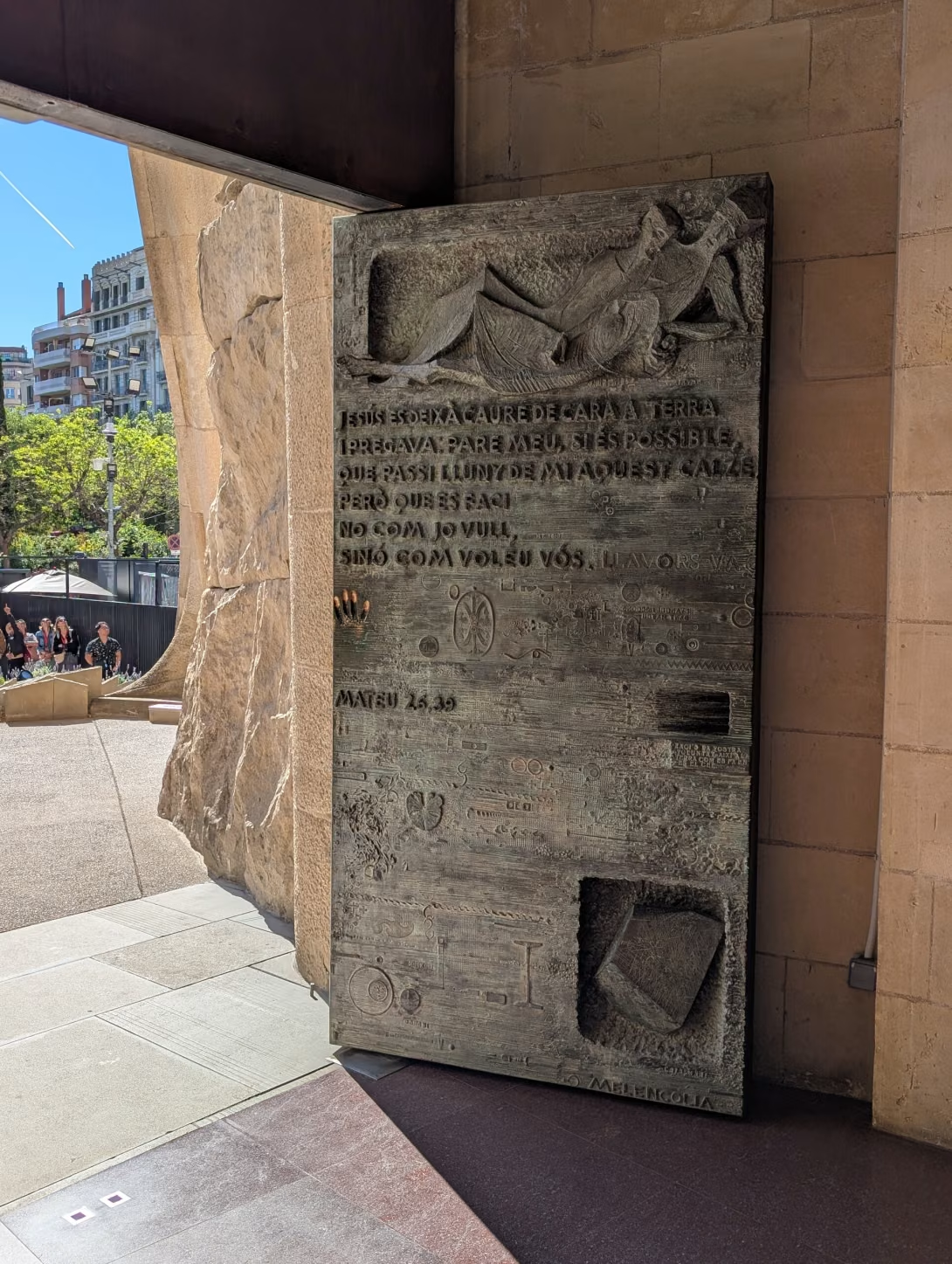
Bronze door leaf open onto the square: a relief of figures, lines of text and a recessed pattern
© Barcelona.com
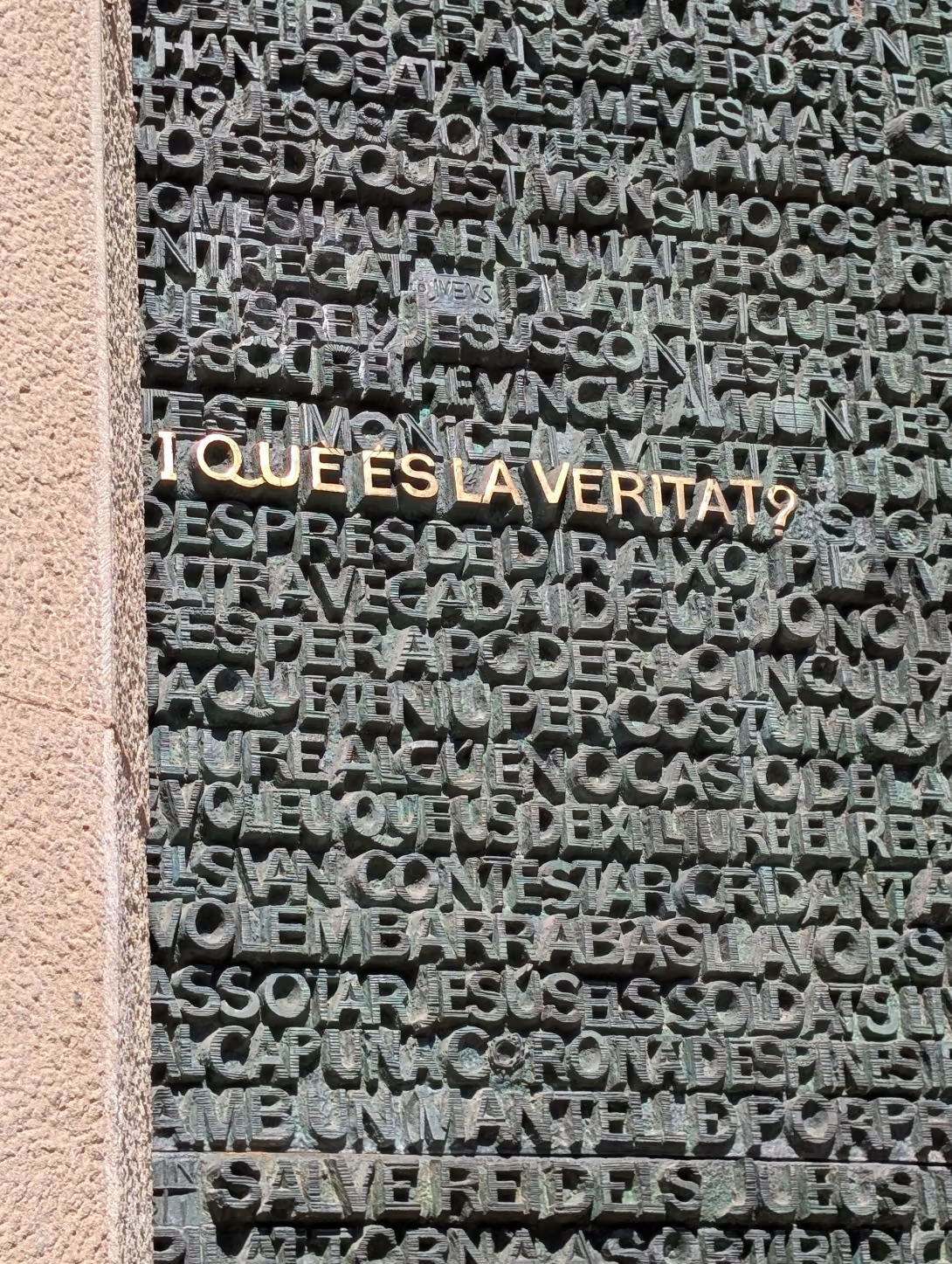
The question 'Què és la veritat?' in light letters, amid the relief text of a bronze door of the Sagrada Família
© Barcelona.com
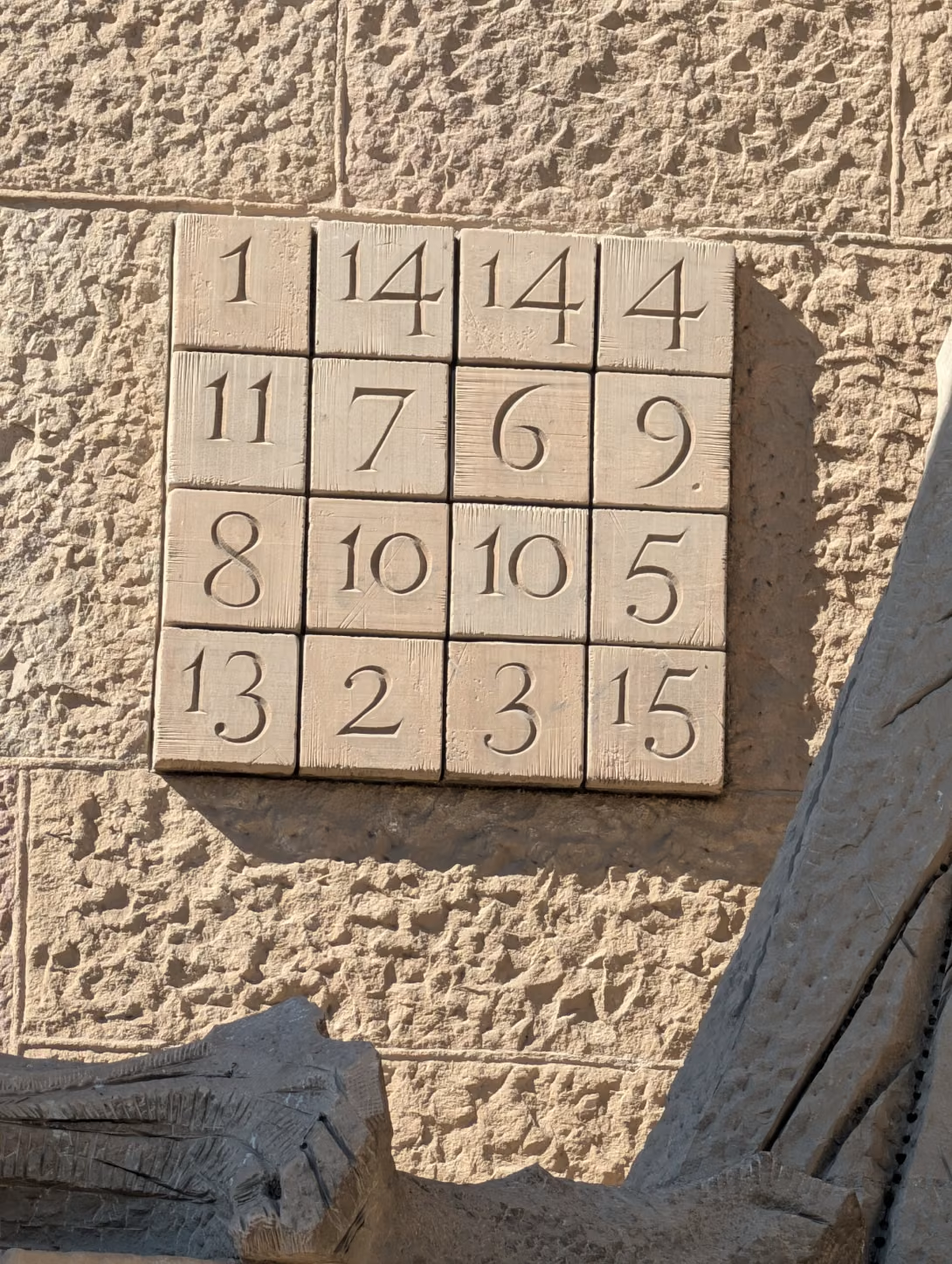
Square of sixteen numbers carved into the stone of the Passion façade of the Sagrada Família
© Barcelona.com
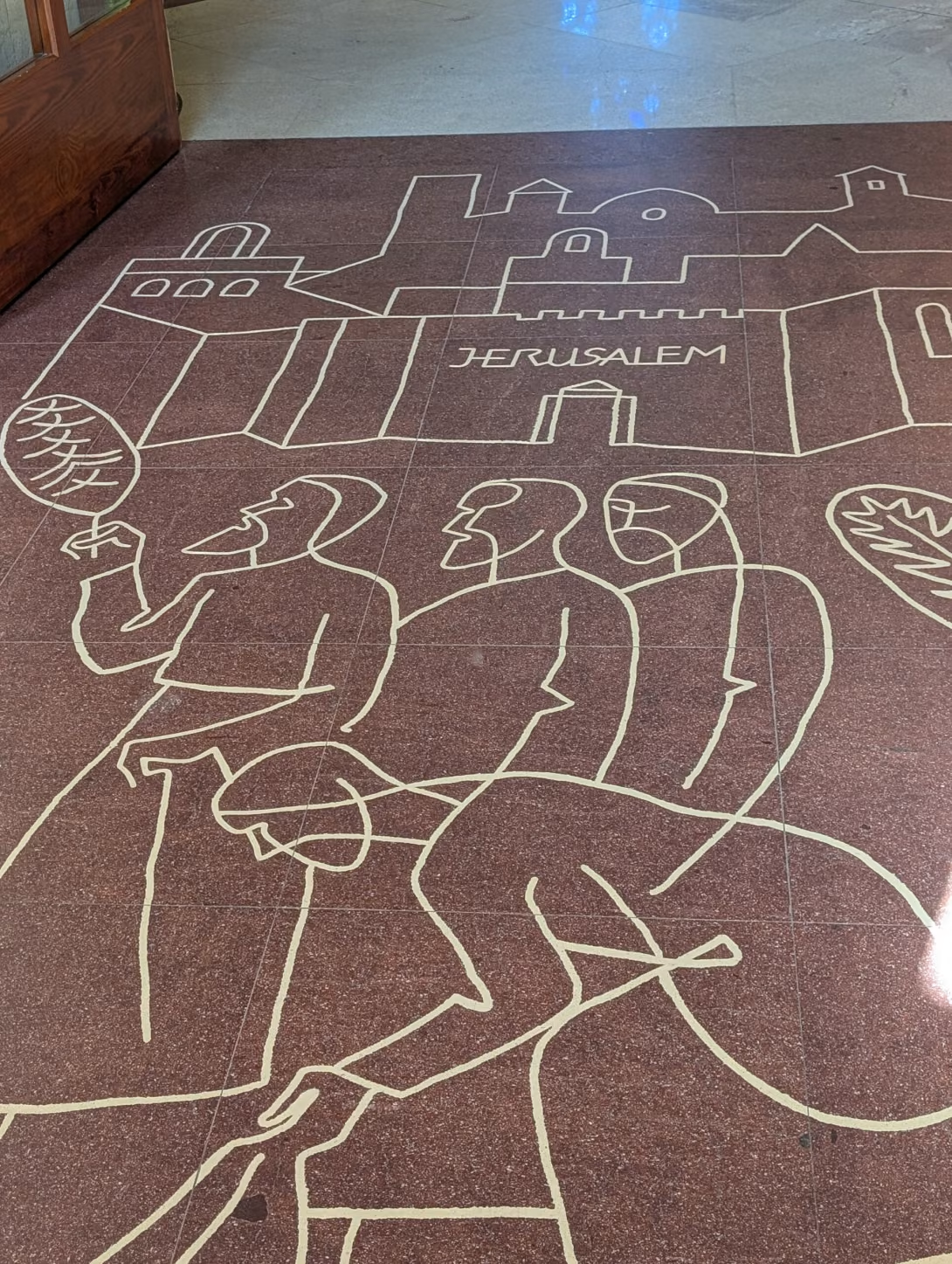
Drawing traced on the floor of the Sagrada Família: figures in front of the walls of a city marked 'Jerusalem'
© Barcelona.com
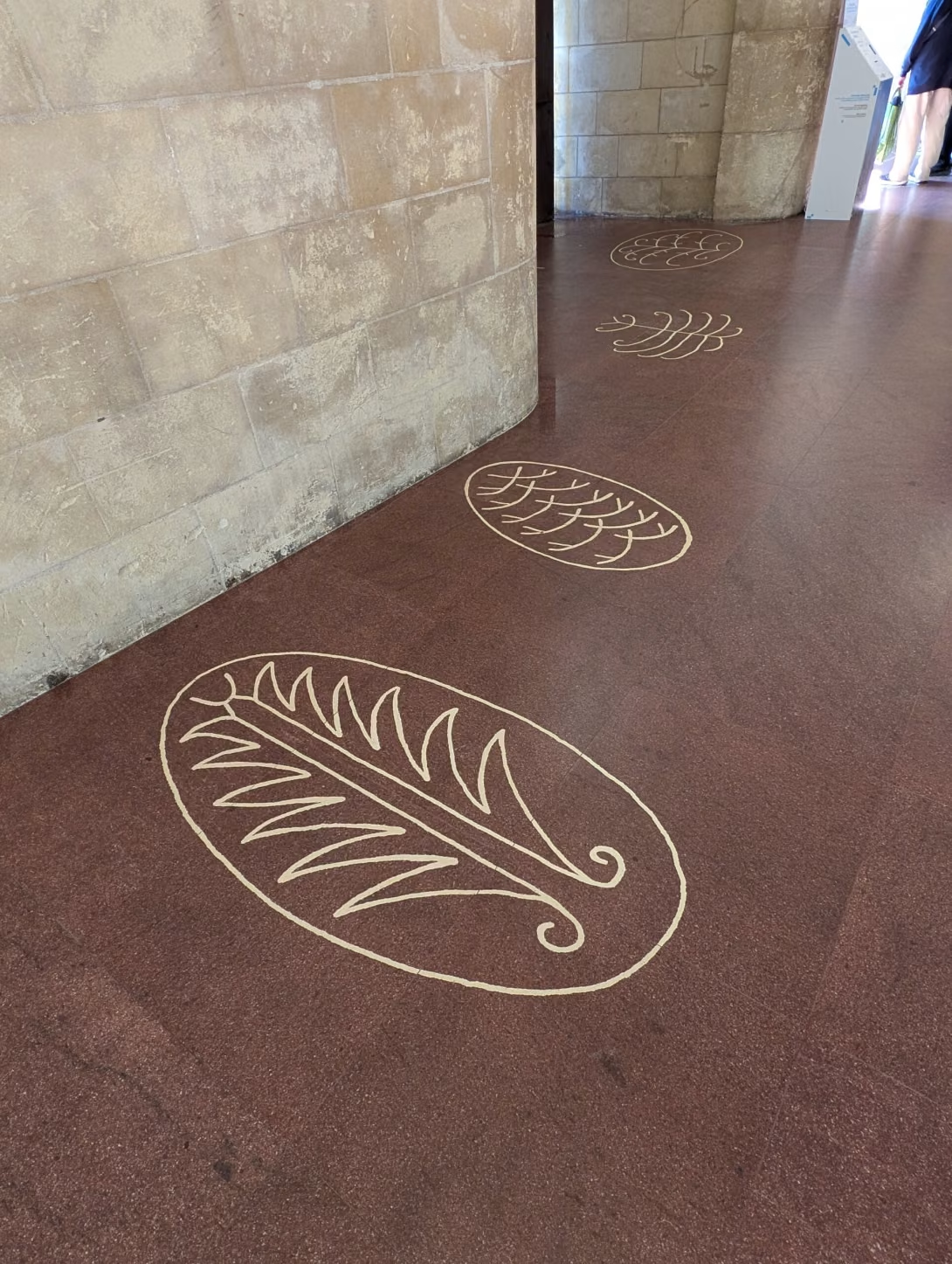
Leaf patterns in ovals, traced in a light colour on the red floor of the Sagrada Família
© Barcelona.com
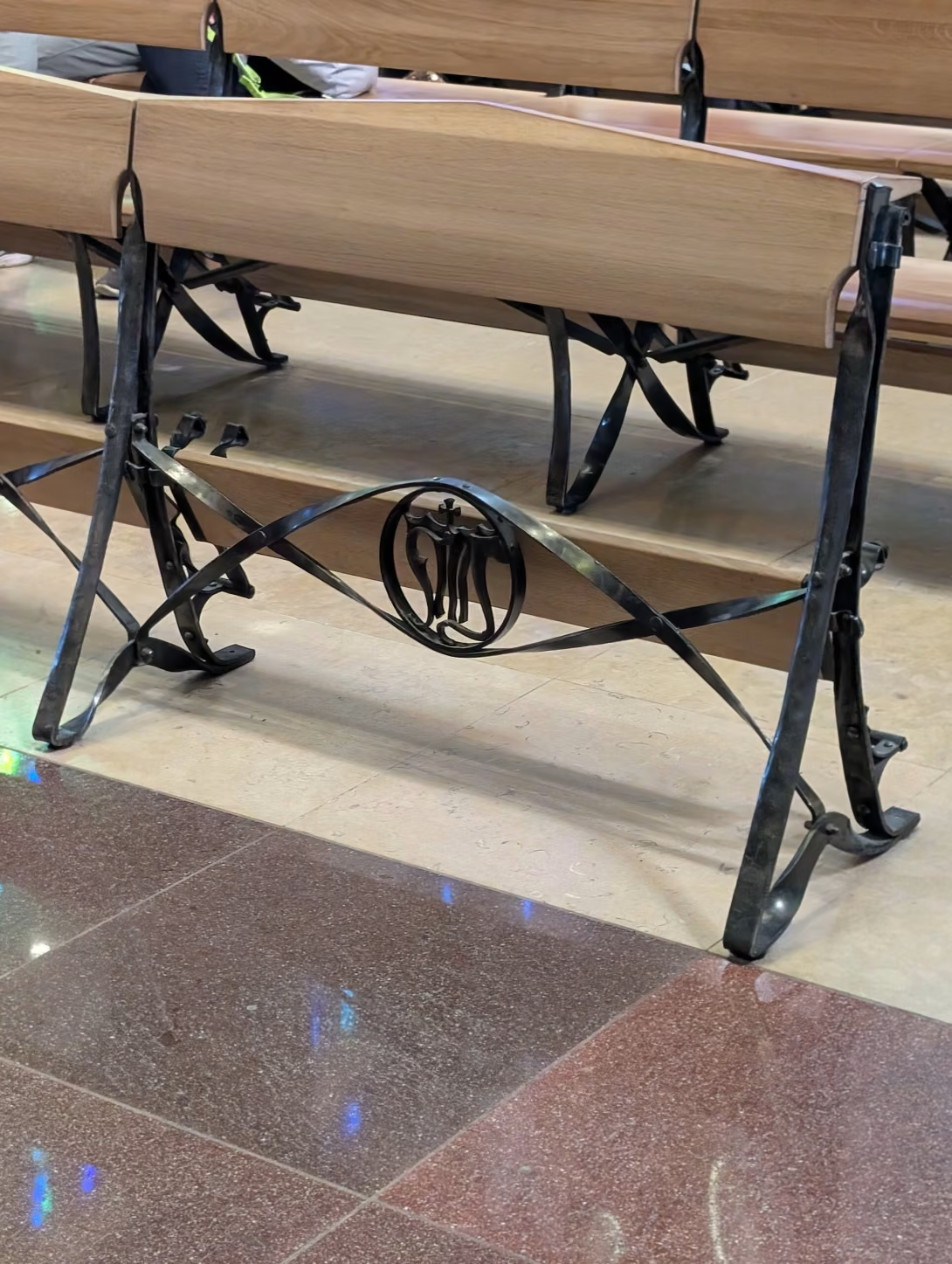
Detail of a wooden pew in the Sagrada Família: a curved wrought-iron base, decorated with a medallion
© Barcelona.com
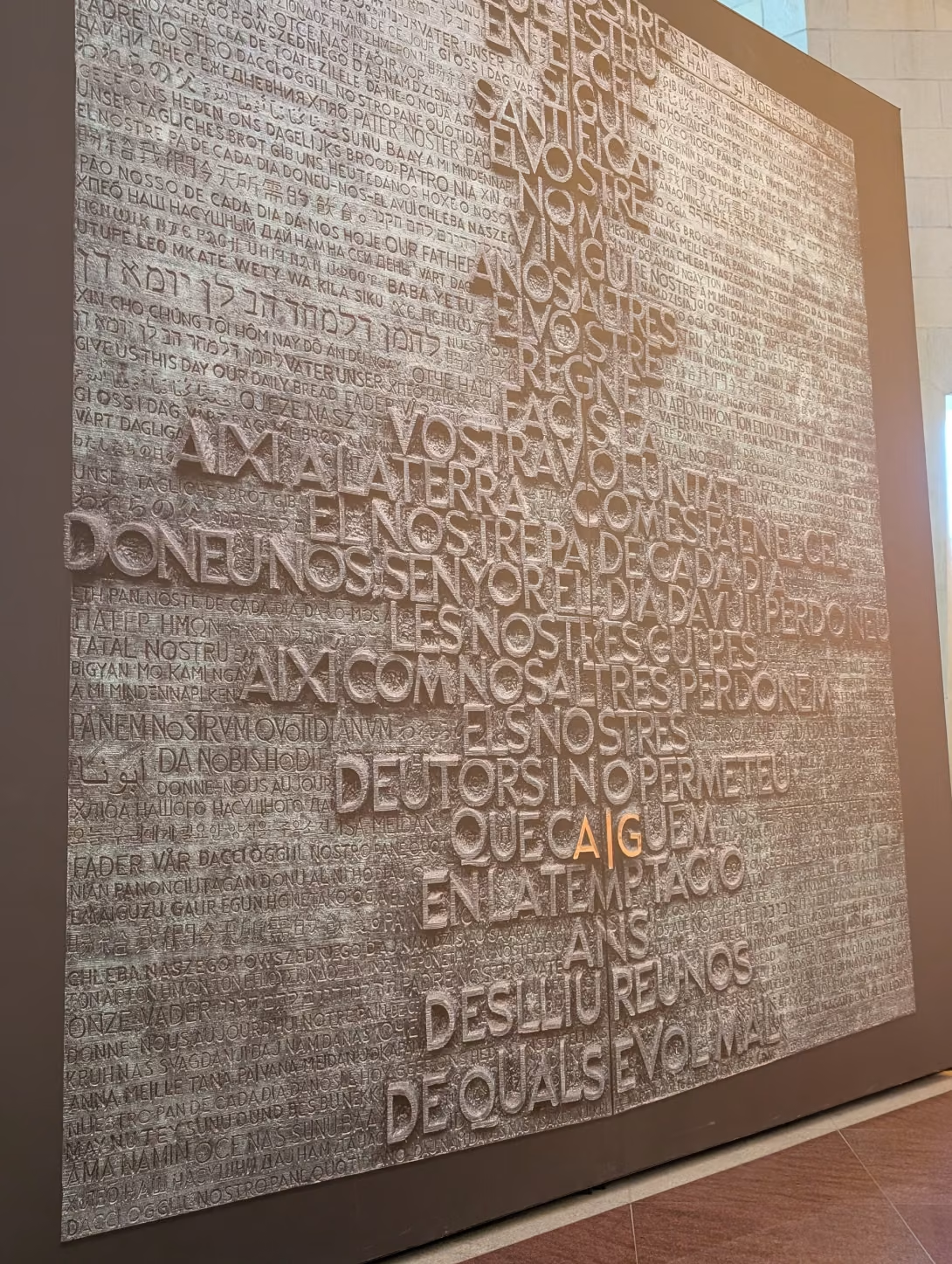
Large panel covered in raised letters, where the end of the Lord's Prayer can be read in Catalan
© Barcelona.com
Visit
The recommended route
Step by step
- Enter through the Nativity façade, Carrer de la Marina.
- The nave: the columns, then the vaults, looking up.
- The crossing and its four porphyry columns with the symbols of the Evangelists.
- The stained glass, on the Nativity side, then on the Passion side.
- The apse, the altar and the baldachin.
- Exit towards the Passion façade.
- The museum, under the basilica, with the view of the crypt.
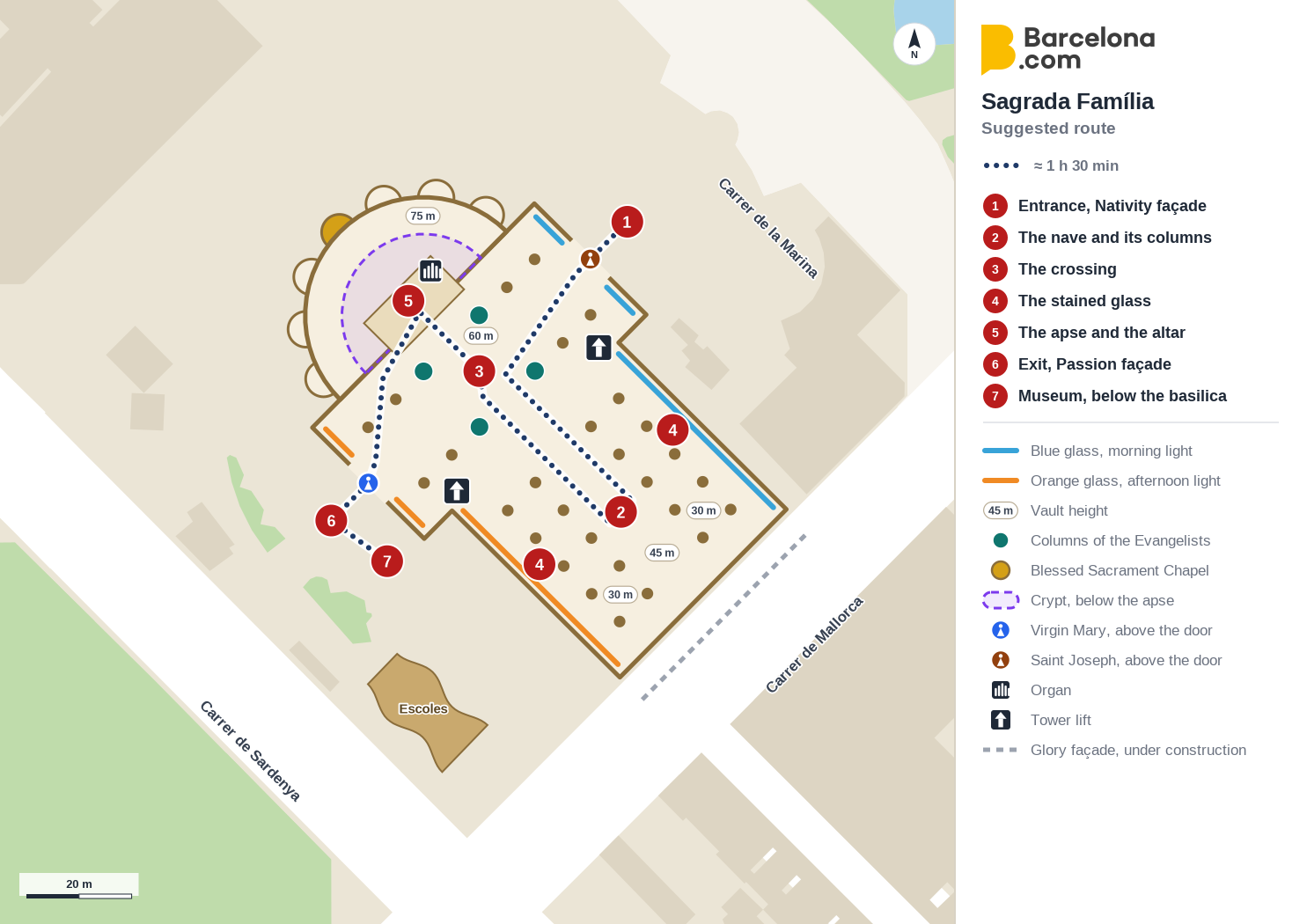
Download the map as a PDF, one A4 page to print.
Our tips
- What time? Morning for the blues on the Nativity side, late afternoon for the warm hues on the Passion side.
- The audio guide in the official app is included in the ticket: download it before you come and bring headphones.
- How long? Allow about 1.5 hours on site, including the museum.
- For quiet prayer: the Chapel of the Blessed Sacrament, in the middle of the apse.
- Photos: tripods and professional equipment are not allowed.
Quiet hour from 9:00 to 10:00. The visit runs as normal, but headphones are required and you must stay silent. Appropriate dress required: no see-through clothing, and shorts and skirts must reach at least mid-thigh.
Make more of your visit
Climb a tower
After the nave, the view from above: our comparison of the Nativity and Passion towers.

Tickets
Book your visit
Visiting the interior requires a dated ticket, booked in advance: standard entry, with audio guide, guided tour or tower access.

Inside the Sagrada Família: frequently asked questions
Yes. Many visitors find it more striking than the façades: the height of the vaults, the tree-shaped columns and the light from the stained glass cannot be guessed from outside.
The nave and its branching columns, the four crossing columns with the symbols of the Evangelists, the stained glass, the apse with the altar and the baldachin, the view of the crypt where Gaudí lies, and the museum devoted to the construction.
About 1.5 hours including the museum. The official audio guide comes in a 45-minute or a 25-minute version.
45 m under the vaults of the central nave, 30 m in the side aisles, 60 m over the crossing and 75 m above the apse.
The Barcelona painter Joan Vila-Grau, who worked on them from 1999 until his death in 2022, following Gaudí's principles: cool tones to the east, on the Nativity side, and warm tones to the west, on the Passion side.
They are "trees" that hold up the vaults. They also carry meaning: the four central columns bear the symbols of the Evangelists, those of the crossing represent the Apostles, and the others dioceses of Catalonia, Spain and the world.
Yes, in the crypt of the Sagrada Família, the oldest part of the basilica, directly beneath the apse.
Yes for personal photos, which are common, but tripods and professional photo or video equipment are not allowed.
Yes, the whole basilica is accessible except the towers. Visitors with reduced mobility use entrance B, on Carrer de la Marina, where wheelchairs are lent subject to availability.