The Icon of Park Güell
Park Güell Salamander: Gaudí's Dragon
Perched on the Dragon Staircase, the famous dragon or salamander covered in trencadís has become the most popular image of Park Güell. This colorful sculpture is also part of the hydraulic system designed around the Hypostyle Hall.
The dragon or salamander in trencadís is one of the most iconic images of Park Güell.

The Essentials
The Salamander of Park Güell at a Glance
| Official designation used | Dragon or Salamander |
|---|---|
| Location | Dragon Staircase |
| Architect of the complex | Antoni Gaudí |
| Decor | Trencadís / ceramic mosaic |
| Connection with Water | The dragon's mouth serves as the overflow for the cistern located beneath the Hypostyle Hall. |
| Recently Renovated | Right paw restoration completed on April 22, 2026 |
Sources: Park Güell, Dragon Staircase, official restoration updates and Turisme de Barcelona. Verified in September 2026.
On the monumental staircase
Where is the salamander in Park Güell?
The salamander is located at the heart of the Dragon Stairway, between the entrance esplanade and the Hypostyle Hall.
The monumental staircase is arranged in three sections. Midway up, the coat of arms of Catalonia appears, and further up, the dragon or salamander covered in ceramic fragments. The official site describes it as the park's most popular image.
Its position is not just decorative: the staircase is traversed by water from a fountain fed by the cistern located beneath the Hypostyle Hall.
Art and Engineering
Why is the salamander both decorative and functional?
Gaudí combines decoration, the movement of water, and architecture here.
A Trencadís Skin
The dragon is covered in trencadís, a mosaic of ceramic fragments that creates its colorful and irregular surface. The French documentation of the park also uses the term "pique-assiette."
The Cistern Overflow
The rainwater filtered from the Nature Square is collected in a cistern beneath the Hypostyle Hall. The official site specifies that the dragon's mouth serves as the overflow outlet.
See details
The salamander of Park Güell from every angle
Plan for additional views: the entire sculpture, head and mouth, details of the trencadís, then a view of the salamander placed back in the Dragon Staircase.
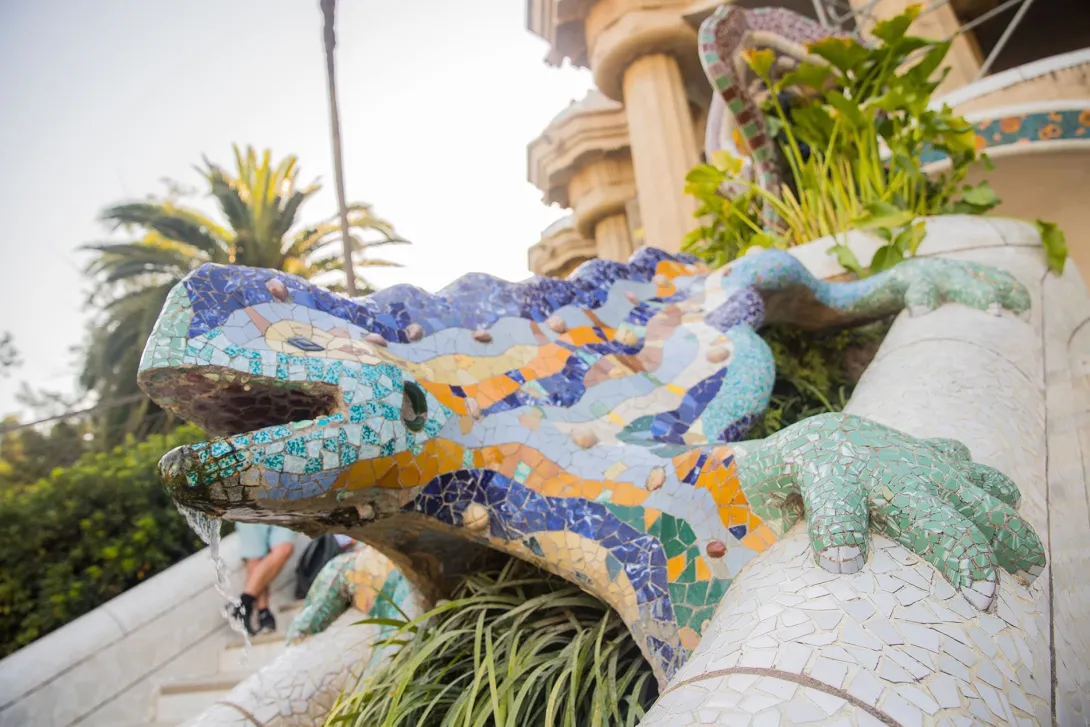
The trencadís salamander on the staircase of Park Güell, front view
© Barcelona.com
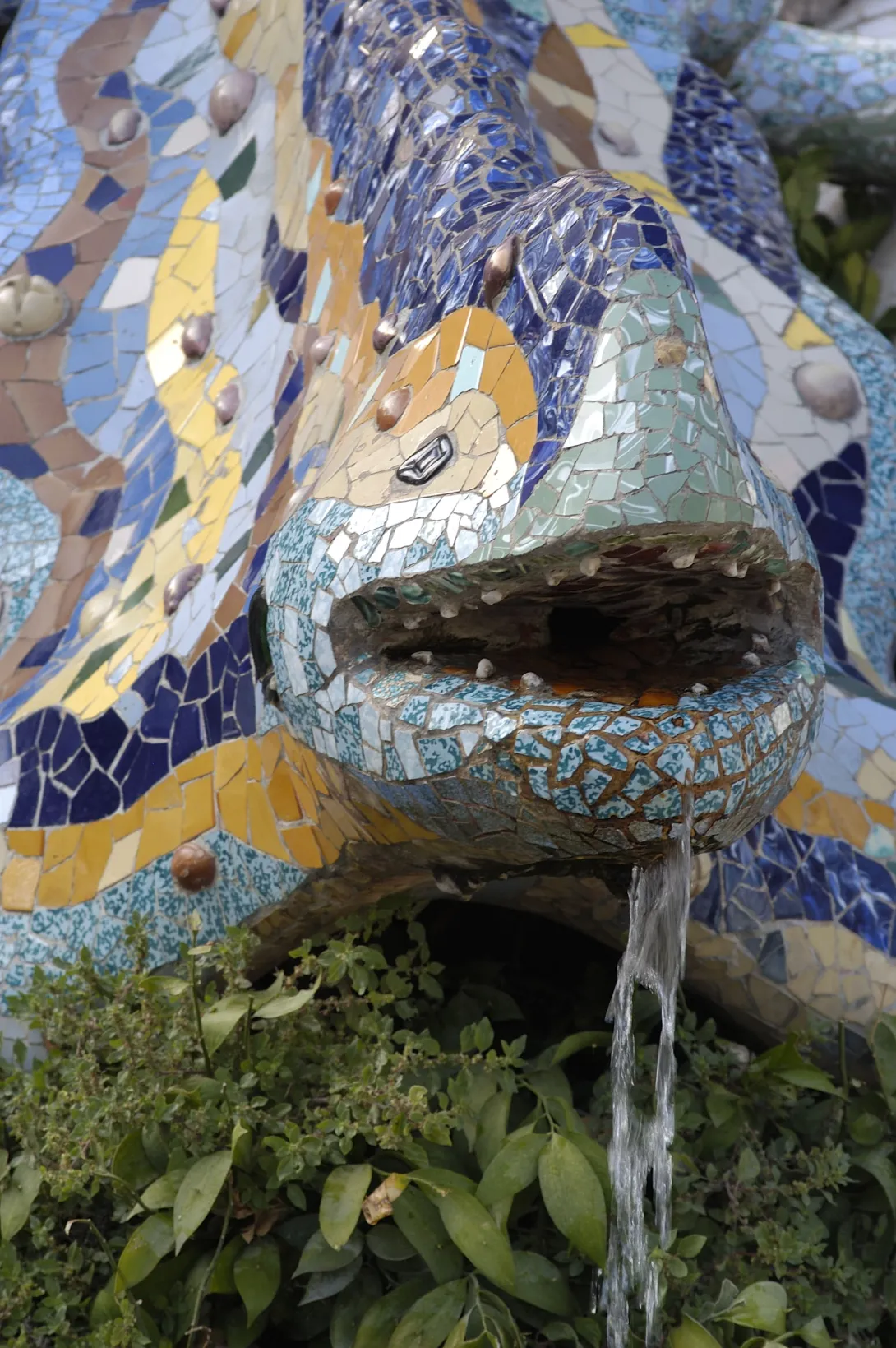
The mouth of the salamander at Park Güell, where water flows from the cistern
© Barcelona.com
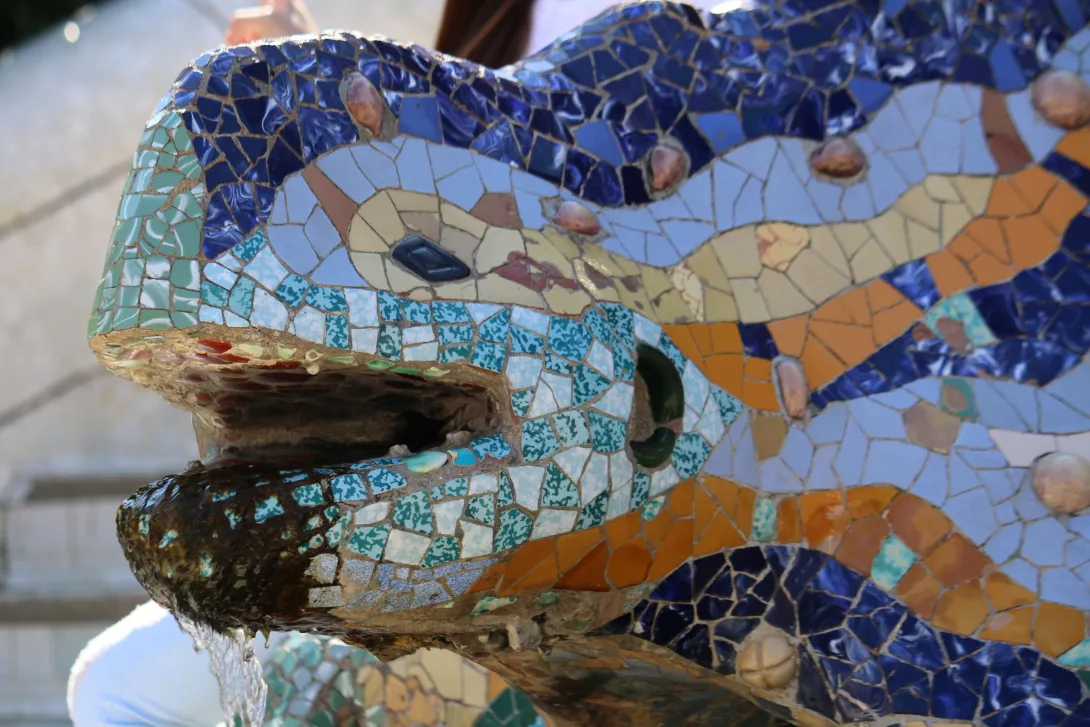
Close-up of the mosaic on the salamander's head at Park Güell
© FrDr, CC BY-SA 4.0, via Wikimedia Commons
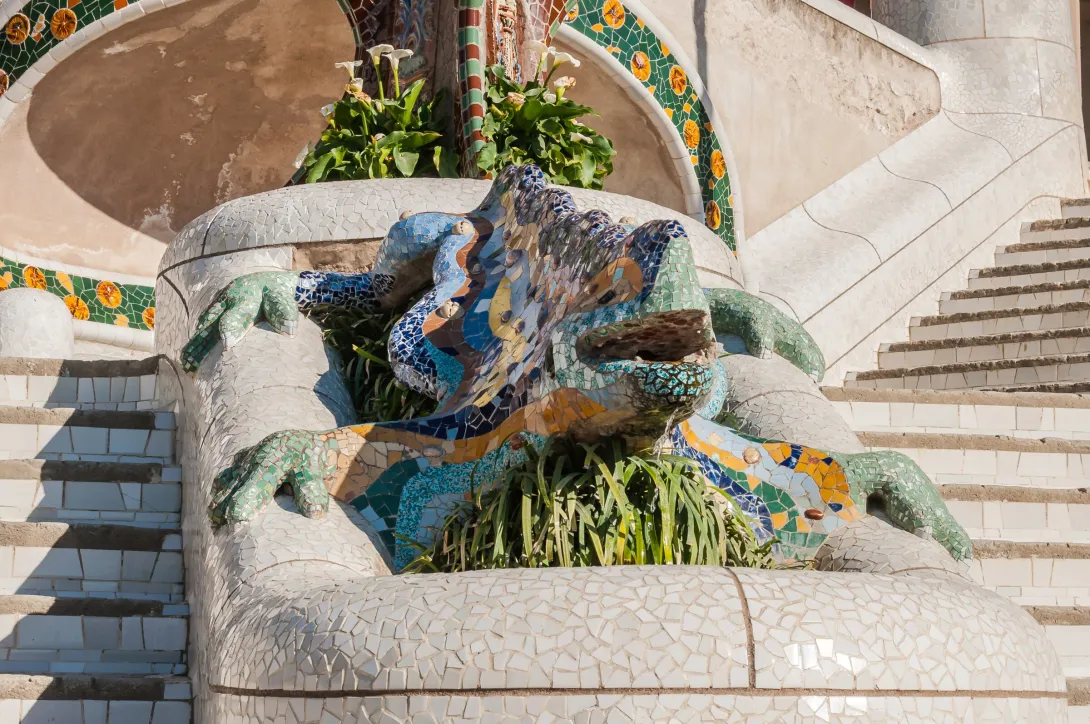
The salamander in the middle of the Dragon Staircase, between the two flights of steps
© Isiwal, CC BY-SA 3.0, via Wikimedia Commons
Symbols
What does the salamander in Parc Güell symbolize?
There is no single official interpretation of the dragon or the salamander.
Park Güell explicitly states that the figure allows for multiple interpretations. The connection to the Catalan legend of Sant Jordi is one possible reading, but it should not be presented as a certain or exclusive explanation intended by Gaudí.
Often presented as a symbol of Barcelona, and sometimes even of Spain, the salamander has become the most reproduced image of the park, appearing on posters and souvenirs. The most accurate way to describe it is as a symbolic figure open to interpretation, which has become the most representative icon of Park Güell and Gaudí's Barcelona.
Conservation
The restoration of the salamander completed in 2026
The right paw of the salamander was the subject of a study and heritage restoration between February 2025 and April 2026.
After analyzing the structure and condition, the piece was returned to its original location. The ceramic fragments of the trencadís were then reintegrated one by one to preserve the visual and material continuity of the sculpture.
The official site dates the completion of this restoration to April 22, 2026.
Continue the tour
Explore Park Güell beyond the salamander
The salamander is part of an architectural ensemble that connects the Dragon Staircase, the Hypostyle Hall, and the Nature Square.
Frequently Asked Questions
FAQ about the Salamander at Park Güell
The official website of Park Güell uses the terms dragon or salamander. The word "lizard" is common in searches and among visitors, but it is not the preferred designation by the park.
Because it has become the most reproduced image of Parc Güell and Gaudí's work, featured on posters and souvenirs alike. There is no single official interpretation of the figure: the connection with the legend of Sant Jordi is one possible reading, which the official site does not confirm as certain.
On the Dragon Stairway, above the coat of arms of Catalonia and before reaching the Hypostyle Hall.
Yes. The Dragon Staircase is part of the monumental zone, which requires a ticket. Details on what is free or requires a ticket at Parc Güell are explained on the Monumental Zone page.
It is covered with ceramic fragments assembled using the trencadís technique, which is prominently featured in the decor of Park Güell.