Barça through the years
History of FC Barcelona
Founded on November 29, 1899, FC Barcelona has become one of the great names in world football and a symbol of Catalonia. From the first neighborhood fields to Camp Nou, from Joan Gamper to Lionel Messi, its history intertwines sporting achievements, political challenges, and popular fervor. To understand Barça is to discover its legendary teams, as well as the connections that unite the club, its members, and the city of Barcelona.
From its founding in 1899 to the great teams of Cruyff and Messi, explore the dates, legends, and identity of FC Barcelona.
- Key Dates Since 1899
- Cruyff, Messi, and the Legends
- The Catalan Identity of Barça

The History of Barça in Key Dates
| 1899 | FC Barcelona is founded on Joan Gamper’s initiative. |
|---|---|
| 1922 | Inauguration of the Les Corts Stadium. |
| 1929 | Barça wins the first edition of the Spanish championship. |
| 1957 | Opening of Camp Nou. |
| 1973 | Johan Cruyff joins the club as a player. |
| 1992 | First European Cup triumph, at Wembley. |
| 2009 | Pep Guardiola's team wins six trophies in the year. |
| 2015 | New treble: championship, Copa del Rey, and Champions League. |
| 2021 | First European title for Barça Women and Lionel Messi's departure. |
| 2024 | The club celebrates its 125th anniversary. |
| 2025 | Home matches return to Camp Nou after a spell at Montjuïc. |
These landmarks trace the major transformations of the club: its establishment in Barcelona, its growth, and its international influence.
Explore further: the history of Barça on the official FC Barcelona website.
1899–1930: the birth of FC Barcelona and its early successes
The story began with an advertisement. In October 1899, Hans Gamper, a Swiss sportsman living in Barcelona and soon to be known as Joan, placed an advertisement seeking fellow footballers in the newspaper Los Deportes.
On November 29, 1899, twelve men gathered at the Solé gymnasium to found FC Barcelona. The group brought together enthusiasts of several nationalities. Walter Wild became the first president, and Gamper would be the main driving force behind the club's development during its early decades. From the start, the association bore the name of its city and welcomed members from different backgrounds.
The early years were marked by uncertainty. Barça changed grounds several times before settling at the ground on Indústria Street in 1909. Football gradually attracted a larger audience, while the first successes strengthened the attachment to the team.
In the 1920s, players like Paulino Alcántara and Josep Samitier became the club’s first great idols of Barcelona. The stadium of Les Corts, inaugurated on May 20, 1922, reflected this growing popularity. Then, in 1929, FC Barcelona won the inaugural edition of La Liga: a foundational title in its sporting history.
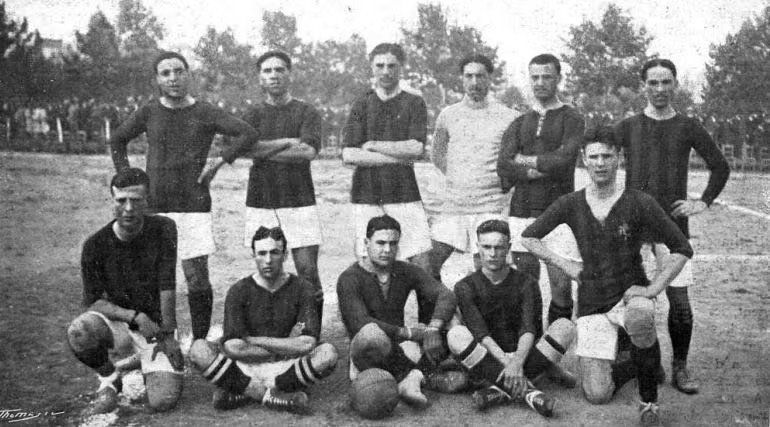
© Frederic Ballell i Maymí, domaine public, via Wikimedia Commons
FC Barcelona in 1910
The team at Ciutadella Park, photographed by Frederic Ballell i Maymí. Document published in La Ilustració Catalana on June 12, 1910.
1930–1950: Barça in the Face of War and Francoism
The 1930s marked the beginning of a painful period. Joan Gamper died in 1930, and the club faced sporting and institutional difficulties. The Spanish Civil War then disrupted its existence.
On August 6, 1936, Josep Suñol, president of Barça and Catalan deputy, was assassinated by Francoist soldiers near Madrid. The club lost its president in a context where its very survival was uncertain.
After the war, the dictatorship imposed its control over the institution. The name and crest were altered, the authorities intervened in the running of the club, and several players remained in exile. For many supporters, matches at Les Corts became a space where a sense of collective belonging endured.
However, recovery began in the 1940s. Barça regained the Spanish championship title in 1945, then again in 1948 and 1949. That year, victory in the Latin Cup signalled its emergence on the international stage.
1950–1978: Kubala, Camp Nou, and the Arrival of Cruyff
Kubala and the Five Cups Team
The arrival of Ladislao Kubala in 1950 transformed Barça. His technique, power, and creativity made him the idol of a generation. Around him, players like Basora, César, and Ramallets formed a team that remains in the collective memory.
The 1951–1952 season is known as the Five Cups season: league championship, Spanish Cup, Latin Cup, Eva Duarte Cup, and Martini Rossi trophy. This term signifies a period of sustained success that significantly boosted the club's popularity.
A New Stadium for a Growing Club
Les Corts was no longer large enough for the growing crowds. Under the presidency of Francesc Miró-Sans, Barça undertook the construction of a new stadium.
The Camp Nou was inaugurated on September 24, 1957. It became the setting for the club's great nights and one of Barcelona's iconic landmarks. Its opening marked a new era: Barça now had a stadium that matched its ambitions.
Cruyff Restores Confidence to Barça
In 1973, Johan Cruyff joined Barcelona after shining with Ajax. Under the guidance of Rinus Michels, he contributed to the 1974 Spanish league title, ending a fourteen-year wait.
This season is also remembered for the 5–0 victory at Real Madrid's ground. Cruyff's talent and game intelligence left a deep impression on the fans. His influence would reach another level when he returned as a coach.
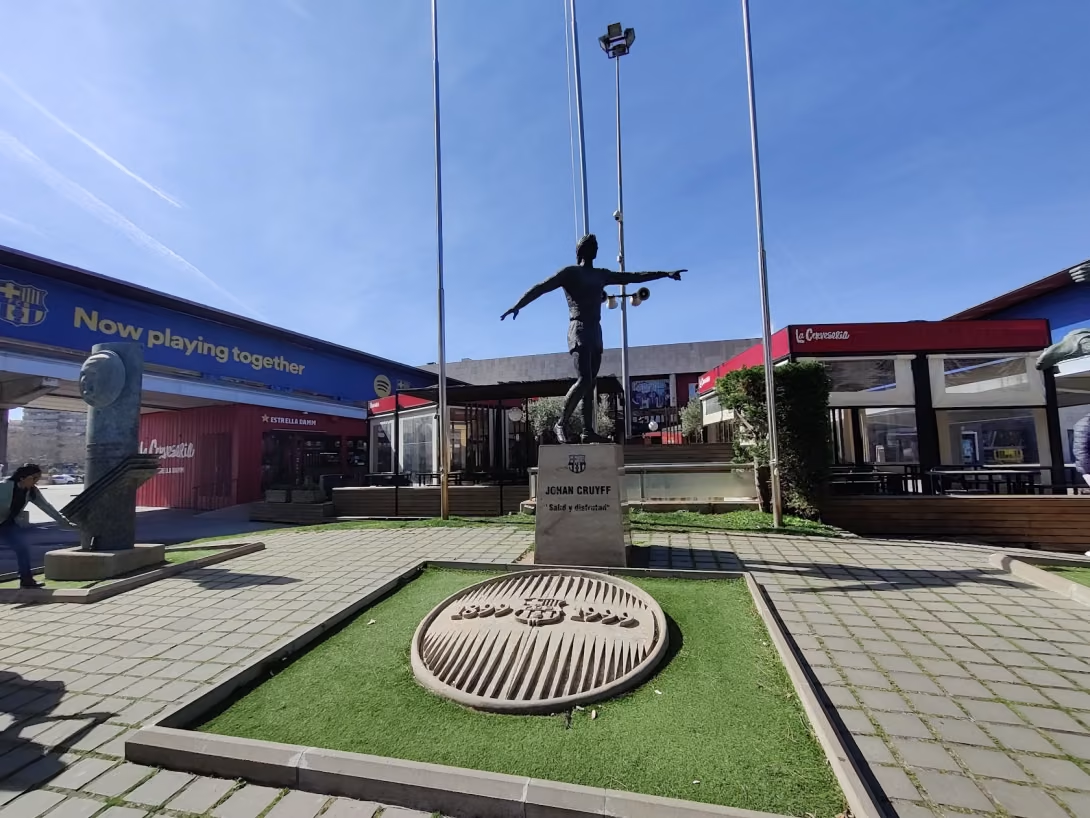
© Barcelona.com
The Legacy of Johan Cruyff
The statue of Johan Cruyff on the forecourt of Camp Nou, photographed in 2023.
1978-2003: the club's expansion and the Dream Team
Elected president in 1978, Josep Lluís Núñez oversaw a long period of growth. The Camp Nou was expanded, membership increased, and the club attracted major international stars.
The victory in the Cup Winners' Cup, in Basel in 1979, was a moment of popular celebration. However, the following years alternated between success and disappointment, despite the presence of players like Bernd Schuster and Diego Maradona.
The sporting turning point came with the return of Cruyff as coach in 1988. He built a team driven by a philosophy of play: control the ball, occupy space, and attack. Koeman, Guardiola, Laudrup, Stoichkov, and their teammates formed the famous Dream Team.
On May 20, 1992, at Wembley, a free kick by Ronald Koeman gave Barça its first European Cup against Sampdoria. This generation also won four consecutive Spanish championships, from 1991 to 1994. They left the club with a legacy that goes beyond their trophies: a way of thinking about football.
After Cruyff, Bobby Robson and then Louis van Gaal won new titles. The centenary in 1999 celebrated the club's continuity, before a more challenging period in the early 2000s.
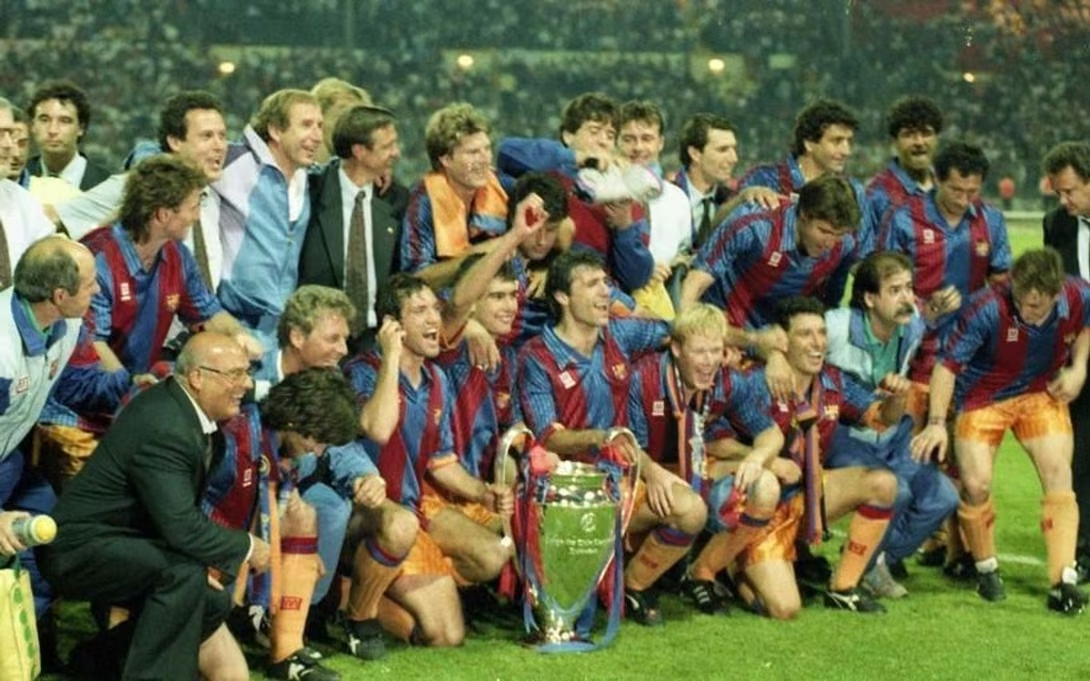
© FC Barcelona
The Dream Team at Wembley in 1992
Barça’s first European Cup, won against Sampdoria.
2003–2021: Ronaldinho, Messi, and the Golden Years of Barça
Ronaldinho and the Return to Glory
From 2003, coach Frank Rijkaard and Ronaldinho symbolised a revival. The Brazilian brought back the joy of inventive football to Camp Nou, surrounded by stars like Samuel Eto'o, Deco, Xavi, and Carles Puyol.
In 2006, Barça won its second Champions League by defeating Arsenal in Saint-Denis. At the same time, a young Argentine trained at the club began to make his mark: Lionel Messi.
Guardiola and the 2009 Sextuple
Appointed as the first team coach in 2008, Pep Guardiola took Cruyff's legacy to new heights. His team combined control of possession, quick passing and an immediate effort to win the ball back.
With Messi, Xavi, Andrés Iniesta, and their teammates, Barça won all six available trophies in 2009: La Liga, Copa del Rey, Champions League, Spanish Super Cup, UEFA Super Cup, and FIFA Club World Cup.
The victory against Manchester United in the 2011 Champions League final at Wembley became another showcase of this style of football.
Messi and the 2015 Treble
Under the leadership of Luis Enrique, the trio of Messi, Neymar, and Luis Suárez led another successful team. In 2015, Barça achieved a second treble, winning the league, Copa del Rey, and Champions League.
Lionel Messi won eight Ballon d'Or awards during his career: in 2009, 2010, 2011, 2012, 2015, 2019, 2021, and 2023. He received the first six while playing for FC Barcelona. These individual awards complement the team’s extraordinary achievements and underline Messi’s place in Barça’s history.
During this period, Messi became the central figure of the club. His departure in 2021 closed an extraordinary chapter, but it also came after several seasons of European and institutional challenges.
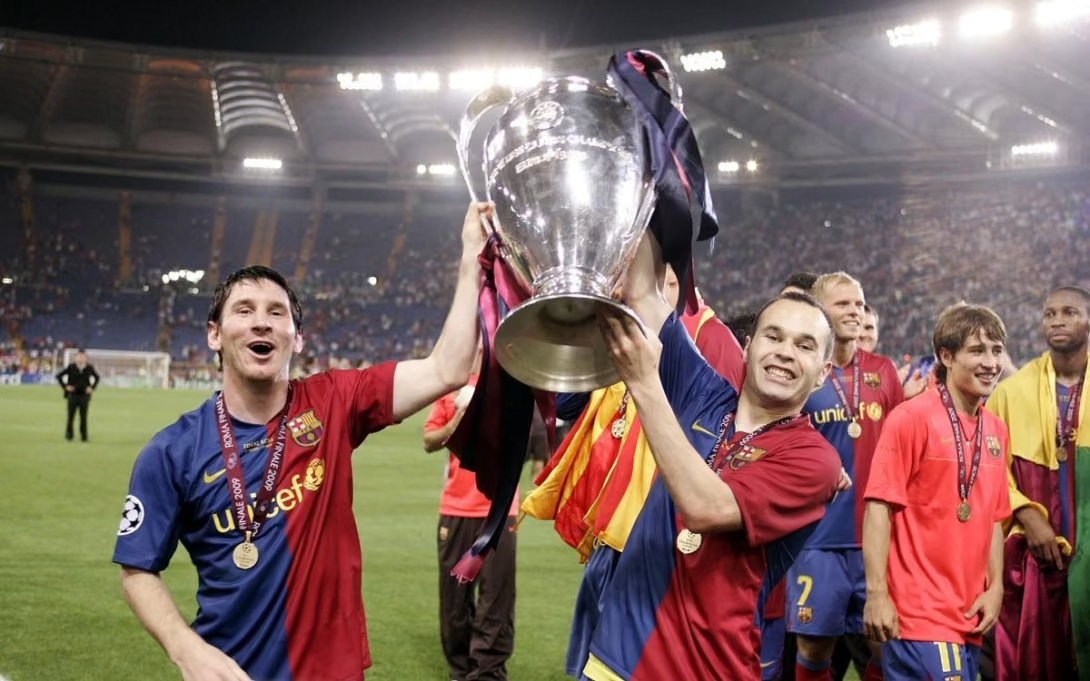
© FC Barcelona
Messi and Iniesta, European champions in 2009
The triumph in Rome, one of the six trophies won by Barça in 2009.
Since 2021: a new chapter in the club's history
After Messi, Barça had to rebuild its sporting and financial stability. Returning as coach, Xavi Hernández led the team to the Spanish championship title in 2023.
Starting in 2024, Hansi Flick opened a new chapter. The 2024–2025 season ended with three national titles: La Liga, Copa del Rey, and Supercopa de España. The emergence of Lamine Yamal once again highlights the importance of youth development in renewing the team.
The club's heritage is also evolving. After playing their home games at the Olympic Stadium in Montjuïc during renovations, the team returns to Camp Nou on November 22, 2025, facing Athletic Club. This reopening marked a milestone in the stadium's renovation.
Barça Women also make history
The history of women's football in Barcelona dates back to a match at Camp Nou in 1970. The team officially became a section of the club in 2002, following decades of development and challenges.
In 2021, they won their first Champions League, with a 4–0 victory against Chelsea. This success adds a new dimension to FC Barcelona's European history, now champions in both men's and women's competitions.
Why is Barça "more than a club"?
An Institution Linked to Catalonia
"Més que un club" means "more than a club" in Catalan. This expression captures an essential aspect of Barça: its sporting role is intertwined with a commitment to a language, a culture, and a collective history.
The phrase was notably popularized by the speech of President Narcís de Carreras in January 1968. It is based on a connection with Catalan society that has been built since the club's early decades and strengthened during periods of repression.
Members and supporters’ clubs
The socios are the club members. Their role in the institution's life, particularly through presidential elections under the club’s statutes, sets Barça apart from many professional clubs.
The penyes are supporters’ clubs. They keep the passion for Barça alive in Catalonia and around the world, organize gatherings, and nurture a community that extends beyond match days.
La Masia and youth development
La Masia represents the club’s approach to developing and supporting young athletes. It combines sports training, education, and personal development. Since 2011, its residence has been located at the Ciutat Esportiva Joan Gamper.
It also embodies the desired continuity between generations: passing on a shared style of play and preparing young people for club life.
Shared Symbols
The blue and claret, the crest, and the Cant del Barça make the club instantly recognizable. The exact origin of the colors remains uncertain: the explanation linking them to Gamper's Swiss canton should not be presented as an established fact.
To discover the lyrics and history of the song that accompanies the matches, visit our page dedicated to the FC Barcelona anthem.
The great victories that have marked FC Barcelona
| Victory | What it represents | |
|---|---|---|
| 1929 | First Spanish Championship | Barça becomes the first winner of La Liga. |
| 1952 | The Season of the Five Cups | The peak of the Kubala generation. |
| 1979 | Cup Winners' Cup in Basel | A great European and popular success. |
| 1992 | European Cup at Wembley | The culmination of the Dream Team. |
| 2006 | Champions League in Saint-Denis | The return to the European summit. |
| 2009 | Six trophies in one year | An exceptional achievement under Guardiola. |
| 2015 | Second Treble | A new generation joins the club's top teams. |
| 2021 | Women's Champions League | A major milestone for Barça Women. |
These victories are milestones in the club’s history, but they do not tell the whole story. Rebuilding, youth development and the commitment of supporters also help explain the club’s longevity.
Discover the history of Barça in Barcelona

© Barcelona.com
Visit the FC Barcelona Museum
Trophies, players, and memorabilia bring the club's great eras to life. The museum extends this journey by giving a tangible presence to the teams and achievements that have built its reputation.

© Barcelona.com
Discover Camp Nou
Inaugurated in 1957, the stadium has been a part of Barça's life for decades. Its transformation now adds a new chapter to this story. As the visiting possibilities evolve with the renovations, please check the practical information before planning your visit.

© FC Barcelona
Attend a match
The chants, the colors, and the reactions from the stands reveal a different level of attachment to the club. Attending a match allows you to experience this history as a tradition that is still very much alive.
Frequently Asked Questions About the History of FC Barcelona
FC Barcelona was founded on November 29, 1899, at the Solé gymnasium in Barcelona. Joan Gamper and eleven other enthusiasts attended this founding meeting. Walter Wild became the first president.
Joan Gamper was a Swiss athlete and entrepreneur who settled in Barcelona. As the driving force behind the creation of Barça, he was both a player and president on several occasions. His commitment played a crucial role in the survival and development of the club.
These colors have been used since the club's inception, but their exact origin is not definitively established. FC Barcelona suggests a connection to a British school attended by the Witty brothers, among its early members.
The men's team won its first European Cup on May 20, 1992, at Wembley, against Sampdoria. Ronald Koeman scored the winning goal from a free kick during extra time.
This Catalan expression means "more than a club". It refers to Barça's ties with Catalan society, its member-based structure and its cultural and social role, beyond sporting results.