The modernist district that expanded Barcelona
Eixample Barcelona: what to see and visit
The Eixample is the grand modernist district of Barcelona. Its grid layout, wide avenues, and chamfered buildings are home to some of the city's most famous landmarks, from the Sagrada Família to Casa Batlló and La Pedrera.

At a Glance
The Eixample at a Glance
| District | Eixample |
|---|---|
| Meaning | Eixample means "extension" in Catalan |
| Urban Planner | Ildefons Cerdà |
| Neighborhoods | Dreta, Antiga Esquerra, Nova Esquerra, Sagrada Família, Fort Pienc, and Sant Antoni |
| Atmosphere | Elegant, residential, modernist, and very central |
| Perfect for | Architecture, monuments, promenades, markets, and stay |
| Not to be missed | Sagrada Família, Passeig de Gràcia, Casa Batlló, and La Pedrera |
| Ideal Duration | Half a day to several days |
| For a first visit | Dreta de l’Eixample and Passeig de Gràcia |
| Where to Sleep | One of the most convenient and central areas of Barcelona |
| Nearby | Gràcia, Ciutat Vella, Sants, and Guinardó |
Major Attractions
Must-See Sights in the Eixample
L'Eixample is home to several of Barcelona's most famous monuments. Most are linked to Catalan modernism, but each has its own story and deserves a separate visit.

© Barcelona.com
Sagrada Família
The Sagrada Família dominates the eastern part of the Eixample. A monumental masterpiece by Antoni Gaudí, it now forms the heart of a residential neighborhood that bears its name.
Carrer de Mallorca, 401 – Sagrada Família

© Fred Romero, CC BY 2.0, via Wikimedia Commons
Passeig de Gràcia
The Passeig de Gràcia is the grand monumental avenue of the Eixample. Casa Batlló, Casa Amatller, Casa Lleó Morera, and La Pedrera can be discovered here during a stroll amidst modernist architecture and grand bourgeois facades.

© Barcelona.com
Casa Batlló
With its undulating façade, vibrant colors, and the famous dragon-like roof, Casa Batlló is one of Gaudí's most instantly recognizable works.
Passeig de Gràcia, 43

© Yair Haklai, CC BY-SA 4.0, via Wikimedia Commons
Casa Milà – La Pedrera
A few streets up, the Casa Milà, or La Pedrera, showcases another side of Gaudí with its undulating stone façade, its courtyards, and its spectacular rooftop terrace.
Passeig de Gràcia, 92

© Txllxt TxllxT, CC BY-SA 4.0, via Wikimedia Commons
Block of Discord
The Block of Discord brings together almost side by side three different visions of modernism: Gaudí's Casa Batlló, Puig i Cadafalch's Casa Amatller, and Domènech i Montaner's Casa Lleó Morera.

© Barcelona.com
Tàpies Museum
Housed in a remarkable modernist building by Domènech i Montaner, the Tàpies Museum combines architecture and contemporary art centered around the work of Antoni Tàpies.
Carrer d’Aragó, 255
One District, Multiple Atmospheres
Understanding the Different Neighborhoods of the Eixample
L'Eixample is too vast to be considered just a small neighborhood. The district is officially divided into six neighborhoods, each with its own distinct atmosphere.

© FrDr, CC BY-SA 4.0, via Wikimedia Commons
Dreta de l’Eixample
The Dreta de l’Eixample is the most monumental part. Passeig de Gràcia, the Quadrat d’Or, and a high concentration of modernist buildings make it the best area for a first exploration.

© Pere López Brosa, CC BY-SA 4.0, via Wikimedia Commons
Antiga Esquerra de l’Eixample
L'Antiga Esquerra de l'Eixample blends elegant buildings, restaurants, cafés, and residential life. The area around Carrer d'Enric Granados and the Casanova axis is particularly lively.

© Martin Abegglen, CC BY-SA 2.0, via Wikimedia Commons
Nova Esquerra de l’Eixample
Further west, the Nova Esquerra de l’Eixample is less monumental and more residential. It's an intriguing area to explore a more everyday Eixample, away from the main tourist crowds.

© Robert Rutkowski, CC BY 3.0, via Wikimedia Commons
Sagrada Família
The Sagrada Família neighborhood is centered around the basilica, yet just a few streets away from the monument, it maintains a very residential atmosphere with shops, cafés, and small squares.

© Barcelona.com
Fort Pienc
Fort Pienc occupies the northeastern part of the district. Less touristy, it develops around the Arc de Triomf, the Estació del Nord, and large residential avenues.

© Barcelona.com
Sant Antoni
Sant Antoni has a distinct identity centered around its large market. Cafés, terraces, and lively streets make it one of the most pleasant areas to experience the daily life of the Eixample.
Don't try to explore all of Eixample in a single walk.
For a first visit, focus on Passeig de Gràcia and the Dreta de l’Eixample, then dedicate another time to the Sagrada Família. Save Sant Antoni or the Esquerra for discovering a more residential and everyday side of the neighborhood.
Gaudí and the Grand Facades
A Modernist Walk in the Eixample
The simplest route to explore the architecture of the Eixample on foot follows the Passeig de Gràcia.
Plaça Catalunya → Passeig de Gràcia → Manzana de la Discordia → Casa Batlló → Tàpies Museum → La Pedrera
From Plaça Catalunya, gradually make your way up the avenue. The Manzana de la Discordia offers a chance to compare several modernist architects almost side by side.
Continue past Casa Batlló, then take a few steps towards the Tàpies Museum, housed in the former Montaner i Simón publishing house. Return to Passeig de Gràcia to finish in front of Casa Milà.
This walk can be completed in 1 to 1.5 hours without interior visits. With a visit to Casa Batlló or La Pedrera, plan for easily half a day.
The Sagrada Família is intentionally left out of this route: it deserves a separate visit rather than a long detour that would make the walk less cohesive.
Highlights of the Walk
Passeig de Gràcia offers the chance to see several modernist masterpieces over a relatively short distance.
- Casa Batlló
- Casa Amatller
- Casa Lleó Morera
- Tàpies Museum
- Casa Milà – La Pedrera
The City Designed by Ildefons Cerdà
Why is the Eixample Built in a Grid Pattern?
L'Eixample literally means "extension". The neighborhood was born in the 19th century when Barcelona was finally able to expand beyond its old walls.
Engineer Ildefons Cerdà envisioned a city organized in a large, regular grid. The streets intersect at right angles, and the buildings are grouped into blocks called illes or manzanas.
The most visible feature is the chamfered corners of the buildings at intersections. These xamfrans widen the crossroads and give the streets of the Eixample their instantly recognizable silhouette when viewed from above.
Cerdà's project also placed great importance on light, ventilation, open spaces, and inner courtyards. The subsequent densification of the neighborhood altered part of this initial vision, but its immense grid still structures the center of Barcelona.
What is a xamfrà?
The chamfered corners of the buildings are one of the distinctive features of the Eixample.
- More Open Intersections
- Increased Visibility at Crossroads
- More Light in the Streets
- A Recognizable Urban Form from Above
Barcelona's Great Architectural Laboratory
Modernism in the Eixample
The construction of the Eixample coincides with the rise of Catalan Modernism at the end of the 19th and the beginning of the 20th century.
The new Barcelona bourgeoisie commissioned the construction of grand buildings and private homes in the neighborhood. Architects were then presented with an exceptional opportunity to experiment with new facades, forms, and decorations.
Antoni Gaudí, Lluís Domènech i Montaner, and Josep Puig i Cadafalch developed very different styles here. Ceramics, carved stone, wrought iron, stained glass, and plant motifs transformed many buildings into true works of art.
The Passeig de Gràcia and the Quadrat d'Or showcase the most spectacular examples, but Modernism can also be discovered in much more residential streets.
To learn more, visit our page dedicated to Modernism in Barcelona.
Three Great Names of Modernism
Three architects help us understand the diversity of Catalan Modernism.
- Antoni Gaudí
- Lluís Domènech i Montaner
- Josep Puig i Cadafalch
Beyond the Monuments
Markets, Cafés, and Neighborhood Life in the Eixample
L'Eixample is not just a neighborhood of monuments. A large part of the district remains deeply residential and can be explored through its markets, cafés, terraces, and shopping streets.
The Mercat del Ninot in Esquerra is a great spot to observe a market frequented by locals. Further south, Sant Antoni has its own identity centered around its large market and bustling streets.
Rambla de Catalunya offers a quieter stroll than Passeig de Gràcia, with many terraces under the trees.
A part of Antiga Esquerra is also known as Gayxample, a historically significant area for Barcelona's LGBT+ community.
For a change of atmosphere
To explore a more everyday side of Eixample, just step a few streets away from Passeig de Gràcia.
- Mercat del Ninot
- Sant Antoni
- Rambla de Catalunya
- Antiga Esquerra
- Enric Granados
Stay in the heart of Barcelona
Where to stay in Eixample?
L'Eixample is one of the best neighborhoods to stay in Barcelona if you're looking for a central, well-organized, and convenient area to explore the city.
Dreta and Passeig de Gràcia
This is the best choice for a first visit: monuments, architecture, and the city center are immediately accessible.
Antiga Esquerra
More residential yet still very central, it's ideal if you're looking for restaurants, cafés, and a lively neighborhood nearby.
Sagrada Família
This area is interesting if the basilica is a priority for you. Just a few streets away from the monument, the atmosphere quickly becomes more residential.
Sant Antoni
A good alternative for those who prefer a more local atmosphere while still being within reasonable distance of the historic center.

Continue the exploration
What to see around the Eixample?
L'Eixample covers a large part of central Barcelona and provides easy access to several very different neighborhoods.
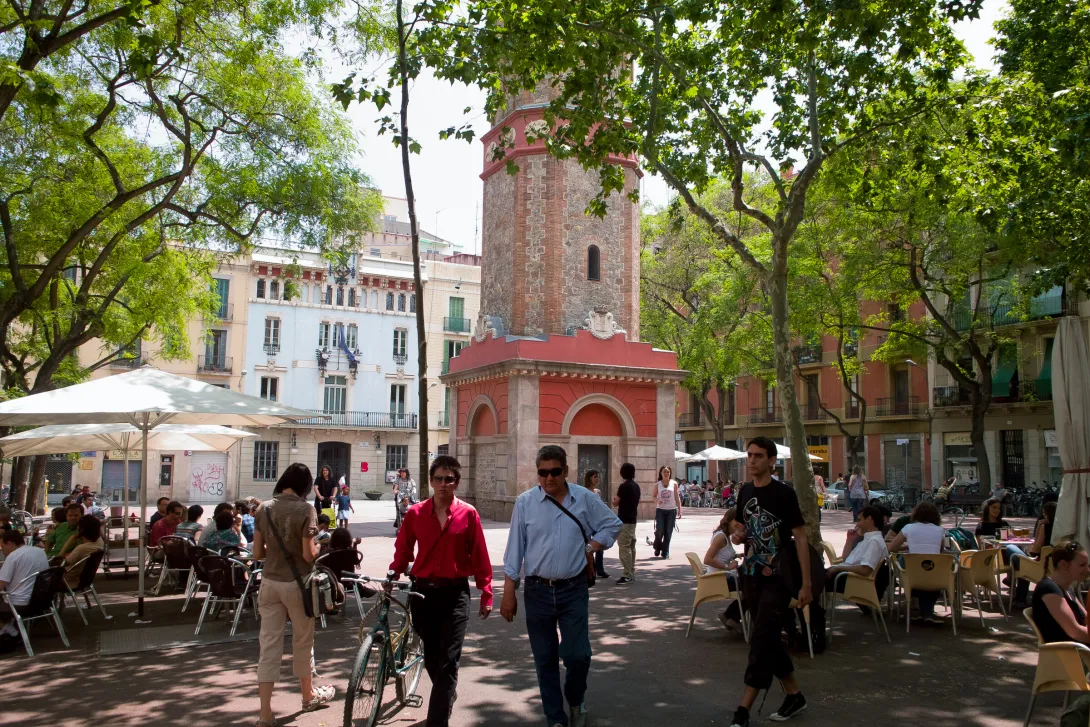
© thierrytutin, CC BY 2.0, via Wikimedia Commons
Gràcia
North of Passeig de Gràcia, Gràcia takes on a completely different scale with its narrow streets, lively squares, and its old village structure.

© Naval S, CC BY 2.0, via Wikimedia Commons
Gothic Quarter
South of Plaça Catalunya begins the ancient heart of Barcelona, featuring the Cathedral, Plaça del Rei, El Call, and the medieval alleyways.

© Barcelona.com
El Born
To the east of the old town, El Born offers a very different atmosphere around Santa Maria del Mar, Carrer de Montcada, the Picasso Museum, and Passeig del Born.

© Barcelona.com
Montjuïc
Further south, Montjuïc offers a break from the urban grid of the Eixample, inviting you to explore gardens, museums, Olympic facilities, and stunning views of Barcelona.
Metro, Train, and Access
Where is the Eixample and how do you get there?
L'Eixample covers a large part of the center of Barcelona. The best station depends on the area you wish to visit.
By Metro
Passeig de Gràcia, Casa Batlló, and La Dreta
L2L3L4 Passeig de Gràcia.
L3L5 Diagonal is convenient for La Pedrera and the upper part of Passeig de Gràcia.
Sagrada Família
L2L5 Sagrada Família.
Esquerra de l’Eixample and Mercat del Ninot
L5 Hospital Clínic is one of the most convenient stations.
Sant Antoni
L2 Sant Antoni.
Also check out our Barcelona metro guide for lines, tickets, and connections.
By Train
The station R2R2NR2S Passeig de Gràcia provides direct access to the heart of the Eixample by Rodalies. It is served without change from the airport (R2 North) and from Sants station, as well as from several destinations around Barcelona.
By Tourist Bus
The two tourist buses pass through the Eixample via Passeig de Gràcia and serve its major landmarks.
Barcelona City Tour
Plaça de Catalunya and Passeig de Gràcia – La Pedrera,
Sagrada Família
Casa Batlló – Museu Tàpies.
Bus Turístic
Plaça de Catalunya and Casa Batlló – Museu Tàpies,
Passeig de Gràcia – La Pedrera,
Sagrada Família.
Which station to choose?
Since the Eixample is quite large, choose your stop based on your first visit:
- Passeig de Gràcia: Casa Batlló, Block of Discord, and the center of Dreta
- Diagonal: La Pedrera and the upper part of Passeig de Gràcia
- Sagrada Família: basilica and Sagrada Família neighborhood
- Hospital Clínic: Mercat del Ninot and Esquerra de l’Eixample
- Sant Antoni: market and southwest of the district
On foot, Plaça Catalunya serves as the natural gateway to the Eixample from the old town. Passeig de Gràcia begins immediately north of the square.
By taxi, specify the monument, market, or street you wish to reach rather than just saying "Eixample": the district covers a very large area.
By bike, the Eixample is one of the easiest areas to navigate: the terrain is flat, the streets are wide, and several major roads have bike lanes, including the Diagonal, Passeig de Sant Joan, Consell de Cent, and Enric Granados. Since Bicing is reserved for subscribers, you'll need to go through a rental service for a day rental.
FAQ
FAQ - L'Eixample in Barcelona
The main sites are the Sagrada Família, Passeig de Gràcia, Casa Batlló, Casa Milà – La Pedrera, and the Block of Discord. The neighborhood is also intriguing for its urban planning, markets, and residential architecture.
The Dreta de l’Eixample encompasses Passeig de Gràcia and many of the most famous modernist monuments. The Esquerra is generally more residential and lively on a daily basis, with markets, cafes, and restaurants.
The Eixample was designed in the 19th century according to the plan of Ildefons Cerdà. Its regular grid and buildings with chamfered corners were intended to improve traffic flow, open up intersections, and enhance light and ventilation.
Yes. The Sagrada Família is located in the Eixample district and even lends its name to one of its six official neighborhoods.
Yes. The Eixample is central, well-connected, and convenient for visiting Barcelona. Passeig de Gràcia is particularly suitable for a first visit, while Esquerra or Sant Antoni offer a more residential atmosphere.
A half-day is enough to explore Passeig de Gràcia and several modernist facades. If you include the Sagrada Família, Casa Batlló, or La Pedrera, the Eixample can easily fill a full day or multiple visits.